Why Do You Stay?

IMG_3884

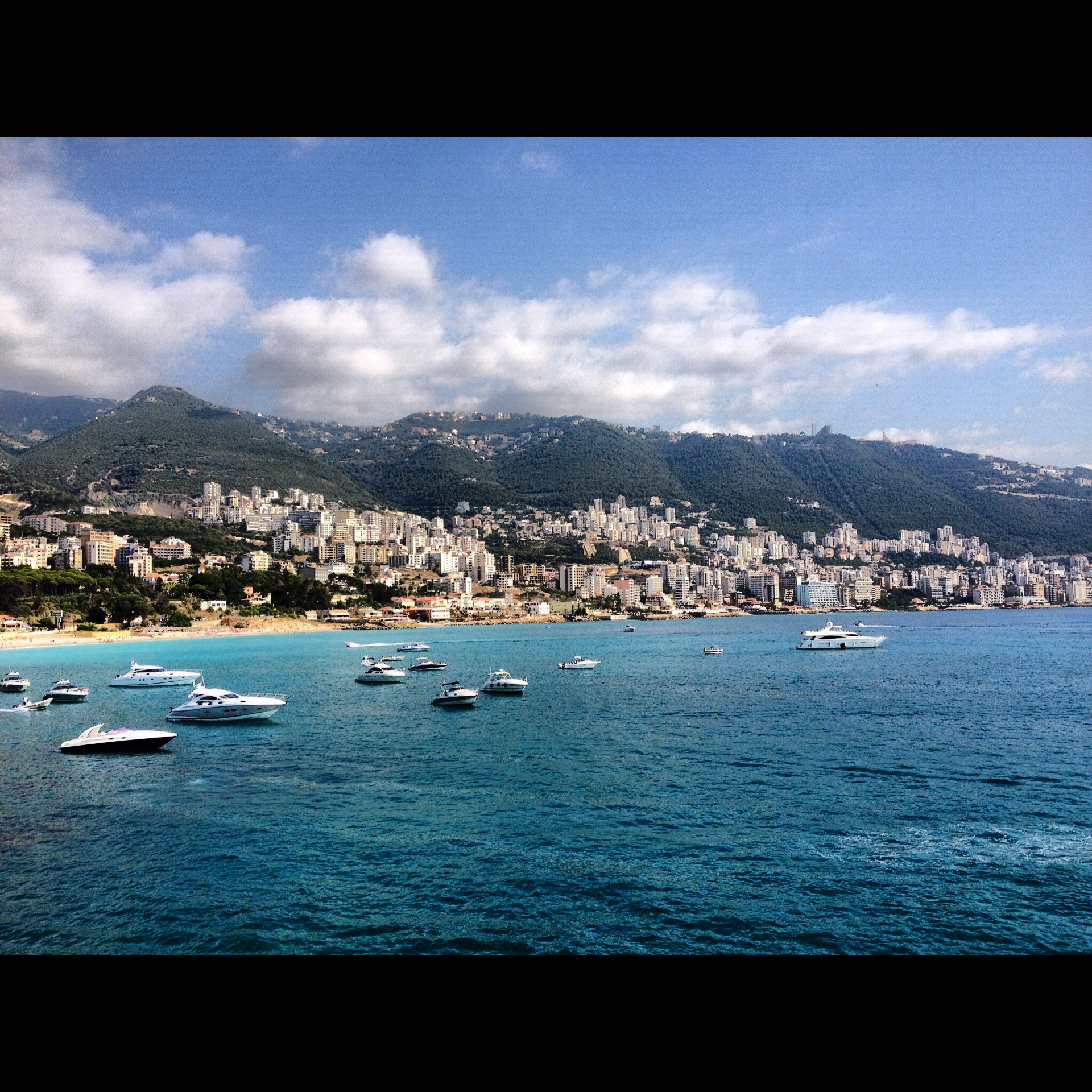
Jounieh Bay, Sept 2012

A friend’s status on Facebook said “What’s keeping me here, I don’t even know” Given recent events, a lot of us are asking ourselves the same understandable question. I know how difficult it can be to live in Lebanon but I know that many people abroad would prefer to be here if circumstances were better. Regardless of where you are right now, I thought I’d write down a few reasons why the collective “you” stay or wish you could.

Why do you stay?

You stay because of your family,
you can’t abandon them selfishly.
You stay because of your job,
you can’t just expect a good opportunity to pop up wherever you go.
You stay because you don’t have a visa,
you don’t have the freedom to just book a ticket for any destination.
You stay because you just bought a car,
you’ve invested in something that is rooted here and it’s yours.
You stay because your Teta is getting older,
you can’t leave when you don’t know how much longer she’ll be around.
You stay because you’re relatively broke,
you can’t afford the living expenses abroad.

No.

Maybe you stay because you want to.
Because your clothes and hair smell like coal after mashewe in June.
Because of the taste of leftover manoushe heated on the soubiyya in January.
Because there’s a lost week of summer that makes an appearance in October.
Because of multicolored plaid patchwork in the plains of the Bekaa in April.
Because of Bliss House Chocolat Mou during the power-cuts of August.
Because of the color of the Jounieh Bay’s waters during September.
Because of chilled janerek rolled in salt in May.
Because of nostalgic reunions thanks to international vacation schedules overlapping during December.
Because the acoustics of the Byblos Port create musical synchronicity with the sea waves in July.
Because of Uncle Deek Nescafe in the car during kazdouras in February.
Because of the sun-rays bouncing on the Mediterranean in the middle of November.
Because of the crunching sound of the melting snow on asphalt in the middle of March.
Because you want to see Lebanon rise not like a phoenix, but like a dragon that will breathe fire not become it.
Because you want to raise your children in the country where they are a part of her soil and stone because you helped save her.
Because you want to call this place home.

Why do you stay?
You stay because you want to.

[mashewe: BBQ/grilled meats, soubiyya: old-fashioned heater, janerek: green plums, kazdoura: cruise in the car]

Strip the City: Dubai Edition

Strip the City is a series on Discovery Science Channel that strips major cities down to their bare bones. It analyzes the infrastructure and unique urban planning that went into building such a destination by explaining the technology and architectural & civil engineering. I recently stumbled across the episode on Dubai and it was pretty impressive. For example, did you know that they relocated an entire coral reef…while keeping it underwater the whole time?

Watch the full episode below:

BeBeirut: A Walk with Ronnie

IMG_7569

Ronnie telling the story of Martyrs’ Square

Ronnie Chatah, founder of Walk Beirut, used to run a hostel in Hamra located behind Makhfar Hbeish. He also used to give his guests a walking tour of the city as part of their stay. Back then, the tour would last up to 8 hours. Gradually over time, he was told he had a knack for being a guide to the city and decided to branch out creating an official walking tour open to all willing to spend part of their weekend exploring the city on foot. Walk Beirut has been going for 5 years now; the stops have changed with time depending on the level of relevance of neighborhoods and safety issues. It was initially launched in 2006 but went on hiatus after the July 2006 war with Israel. Now going continuously since 2009, Walk Beirut is a great way to reignite the love of your own city or to discover it as a foreigner – even if you’ve lived here all your life. Tours now last around 4 hours and you need to reserve a spot ahead of time (tickets are $20/person). You can find them online here and check out their Facebook group here and I will be posting a mini interview with Ronnie within the next few days.

IMG_7558

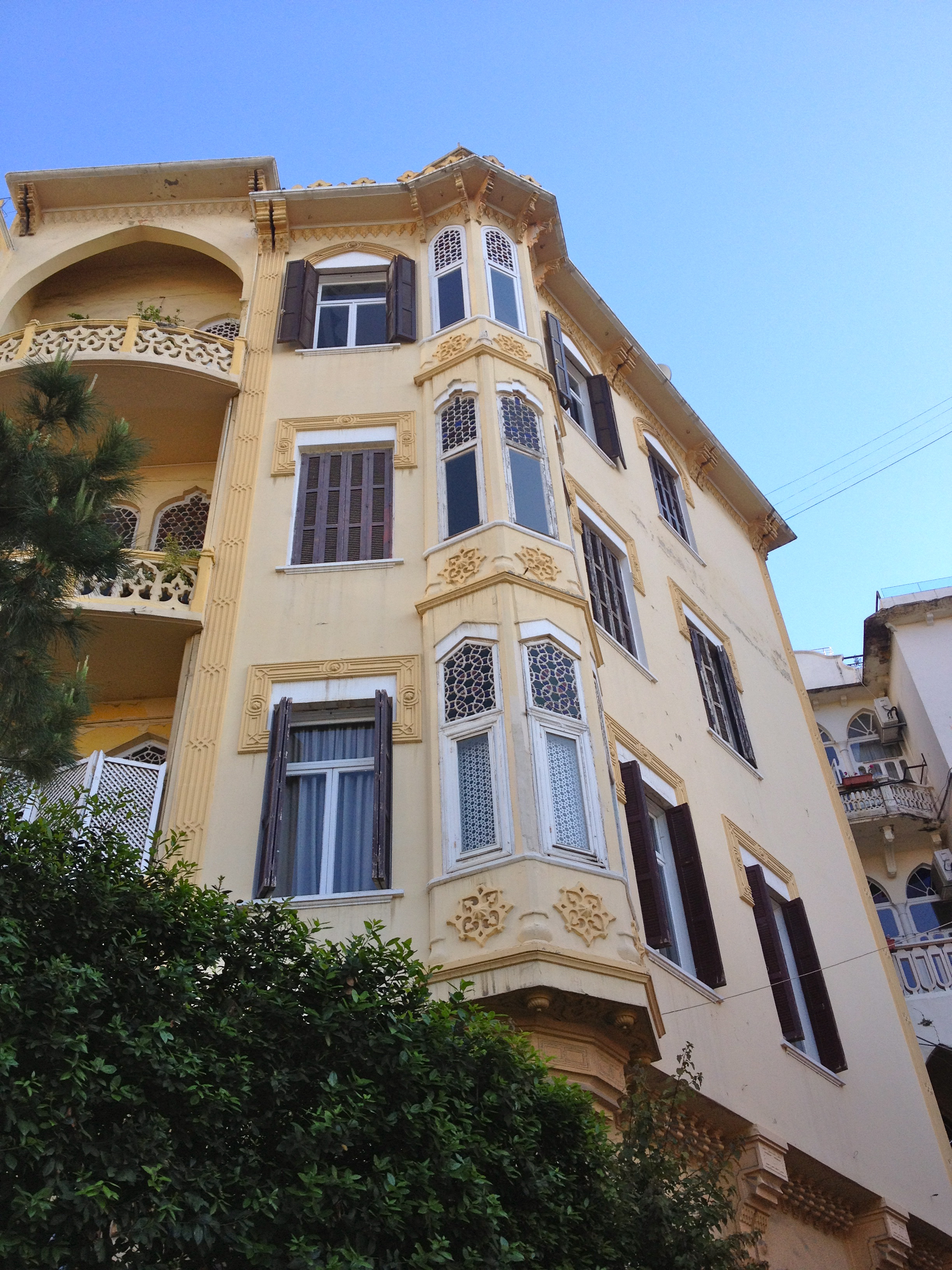
The harem rooms are the solitary rounded windows sticking out, Ottoman architectural influence

The tour is more like listening to a story about our beloved city with a buried past. Ronnie touches on a lot that is wrong with the country but in an entirely factual manner; a very “it is what it is” bittersweet ode to how the city has been crippled by exterior forces but mostly by itself yet still remains to get under your skin. From the architectural influence of the Turkish and the French to the reason we still use American dollars as currency, there are many factoids that even locals will find surprising. For example, the original rotating rooftop bar was at the Holiday Inn, the almost-40-year-old relic towering behind the Phoenicia Hotel. Home to “the original SKYBAR” as Ronnie put it, the hotel was only operational for one year before the civil war broke out.

IMG_7568

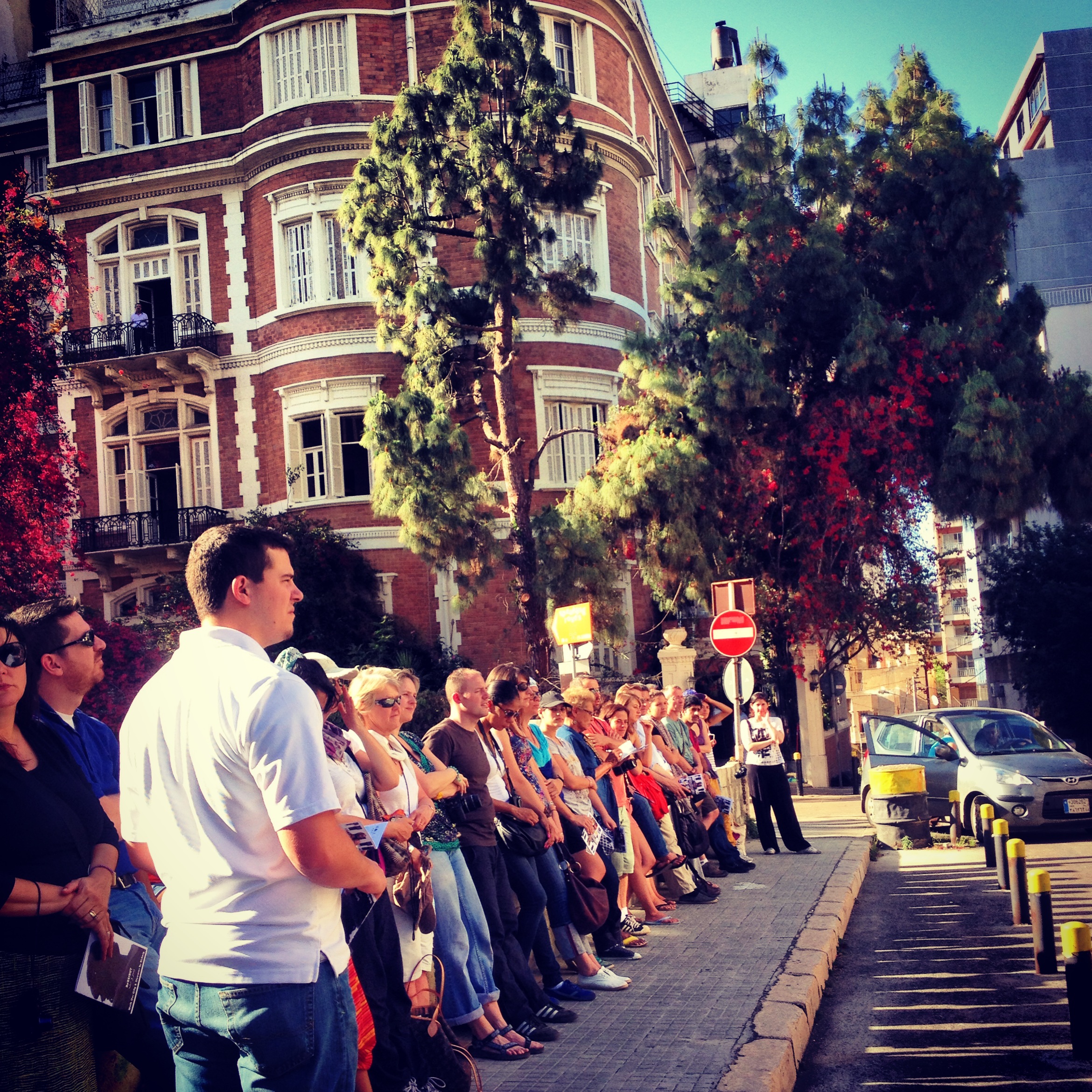
Foreigners in front of Trad “Boutique” Hospital

The tour caters mostly to tourists – I met a Dutch freelance photographer, a few Americans, and two British ladies vacationing here after one had won tickets to stay at Le Gray at an auction in the UK. I found it disconcerting that foreigners seem more heartbroken by our history than our own people. In Samir Kassir’s “Beirut”, Robert Fisk wrote, “I am suspicious of foreigners who tell me they love Beirut. I love the life I live in Beirut, but I think you have to be homegrown – or at least Arab-grown- to claim a city like Beirut as an amour.” It can be argued that those who visit do not have to endure the everyday troubles that residents deal with; they can live in the romantic fairytale and leave before reality strikes. Plus, they probably don’t deal with electricity cuts. Beirut is a self-loathing lover you don’t want to leave because you know she can be beautiful if she just opens her eyes and tries – magical in all her attempts to shine no matter how many times she falls. However, it is still upsetting that foreigners are moved by the story of Martyrs’ Square, a piece of our history that seems to have been neglected. One phrase stuck with me personally during the walk through the ruins of Roman baths located below the Ottoman-built Grand Serail Parliament Palace and literally underneath the French-built bank buildings: “We chose reconstruction over preservation.” We have chosen reconstruction over preservation in the past one too many times, maybe it’s time to preserve our country’s legacy instead of restoring its self-destructive patterns.

We should appreciate the contradiction that makes us so dysfunctionally wonderful but we should work to better it because our beautiful country is sinking again, and we can’t continue to blame others for its fate. As unfair as it may be, it is up to us – the youth- to change things. We need to resuscitate and revive the Beirut that is asleep beneath the ruins and damaged exteriors. Complaining may make you feel better about a current situation but that only gives temporary alleviation; making the decision to change is the only solution for improvement. Lebanon, you are so frustrating only because of your wasted potential. I want more for you. You are richer than any nation because you have culture, history, and pride – things that cannot unnaturally emerge from the sands: they flow in the veins of your people and in the waters that wash away layers of destruction every few years.

Enough drowning, it’s time to swim.

In This Economy…

DSC03594

HA. This is not about the economy. It’s about flying Economy. 3al Libnené.

Assuming that luck has not been on your side [ a) you were not upgraded b) there are lots of babies on board c) there are no empty seats near you d) you got no spare pillows and you’re caged in a non-window non-aisle seat surrounded by people with whom you share no common language], then let this be known: you are not alone in your struggle. Others have been there too.

Before boarding, you will have to say bye to your departure-team of peeps who will preach about the airport being a metaphor for life; people coming & going and there being a sacred bond between those you see around you saying goodbyes and others being reunited with those that were temporarily lost to them as they were suspended in the air. Yes, my team is my parents and it is all morbid and profound.

Immigration control at the Beirut Airport is like watching MBC dramas without subtitles – you can create your own stories. In the line for “foreigners”, travelers with non-Lebanese passports, there’s a bunch of dual-nationality Lebanese people with 3 purebred white Americans. Everyone in this line is wearing sneakers and there’s at least one guy with a fanny pack (banana hammock). Two very Arab looking men with no luggage, who you will automatically nickname The Osamas, will be discussing their kids’ Australian tuition while you wonder where they’re keeping all their travel gear. One Osama only has a neck cushion and the other is just wearing this military khaki vest. He opens said utility vest to reveal multiple pockets and you’re like “ohhhh, note to self, tell Air Marshal.” Another victim of the media’s effective brainwashing. Your racial profiling dudes who could basically be your own dad. The 3 legit foreigners turn out to be 1 French man who has no patience for this merde, and 2 Americans who happen to be from the same town. Or at least that’s what the guy said to get the girl talking, “NO WAY, Bayford Junction?”  The Lebanese-passport line is a bunch of Pointure boots attached to entities with chronic bitchface.

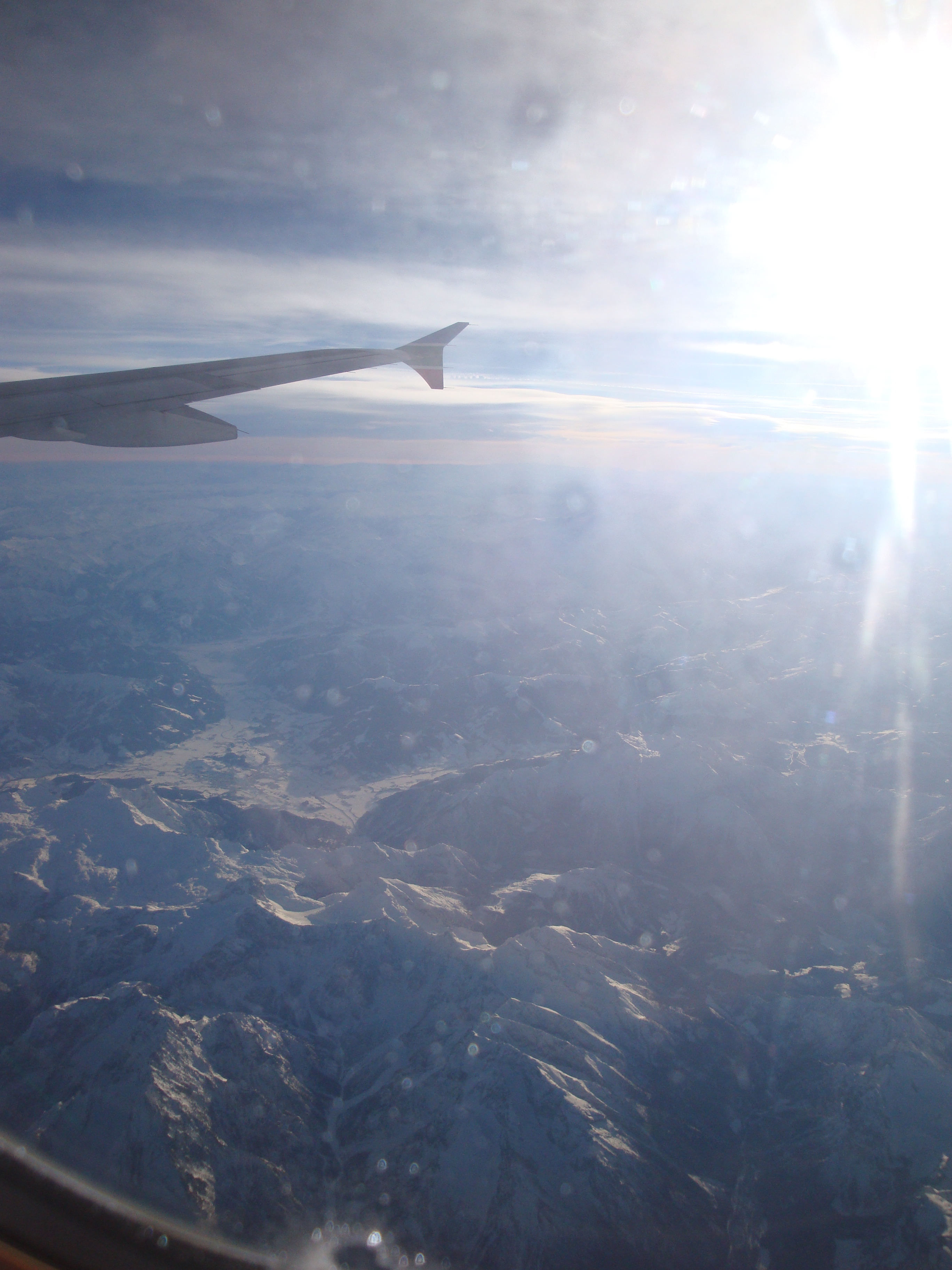
After being delayed because of some “mechanical issues” – oh, that’s comforting – you’re nice and snug in the seat that might as well be a glorified barstool. You’re in for a real treat; you can watch the plane take-off because they’ve got cameras installed on the belly of the aircraft. How nifty technology can be. These kids from Melbourne are bouncing around behind you with their adorable little accents that make a destination sound like an endangered species from down under. Or a house elf. “Mummay, are we going to stawp in the eyre above Aboo Dahby?” As it turns out, they’re watching the take-off too and no, you’re not eavesdropping because it’s Economy, everyone just has one big conversation. Since you’re taking off at midnight and the resolution is worse than a Skype call on dial-up, there’s not much to see but you stare at the runway lights that melt into stars.

“Look mum, it’s granddad.” “Yeah we’re a bit closer to him now.” 
Oh, bloody hell now you’re tearing. Everyone’s a poet.

A selection of 97 movies with classics including Dial M for Murder, Roman Holiday, and a bunch of stuff from Bollywood- but you will scroll through them all, save one for later, and still manage to go “meh, I’ll just watch Friends again.” Just goes to show, people will never be satisfied.

What a cute menu! Oh you’re having the fish with a side salade Chinois, assorted cheeses & crackers, and mango cheesecake? Look, unless you’re in First Class, the chicken tastes like the fish and the fish tastes like the chicken, that other stuff is what they decorate entrees with in real restaurants, and you know that cheesecake came out of a can. BYOB: bring your own buffet. Just don’t pack it in the…

Carry-on in the overhead compartment. Because everyone placed the equivalent of a mid-sized sedan trunkful in your little designated spot, you had to jam your Swiss carry-on 5 rows down. Not only can you not get to your bag easily during the flight but you also have to wait for everyone to disembark the aircraft when you want to leave because no one is going to let you go backwards down the aisle when they want to GTFO. Sit tight because that bought you an extra 45 minutes in the same position.

Eight hours of pure nothingness pass. Time gets screwed when you’re up in the air. First, there’s “airplane eternity sleep”. Remember that time you woke up after a night out and you were like “LOL it’s 3 pm, so what’s for lunch?” It’s like that, only you didn’t sleep 14 hours, you’re still flying over India, and that armrest has nudged itself into your back again. Where’s that damn pillow? Then, the last 3 minutes of a flight are in microwave minutes: it’s just like when you’re heating up a plate of leftover Szechuan chicken and the last 15 seconds go slower than the first 120 just because appliances are secretly evil. You will trudge out in your sweatpants looking like you rolled out of a tapestry without the effortless sex appeal of Cleopatra. You’re a frumpy mess that’s 3 hairbrush-strokes away from Mufasa. You will search for a normal sized bathroom stall that doesn’t smell of humans and Detol. You will spend the next week possibly jet-lagged and groggy.

And you can’t wait to do it all over again.

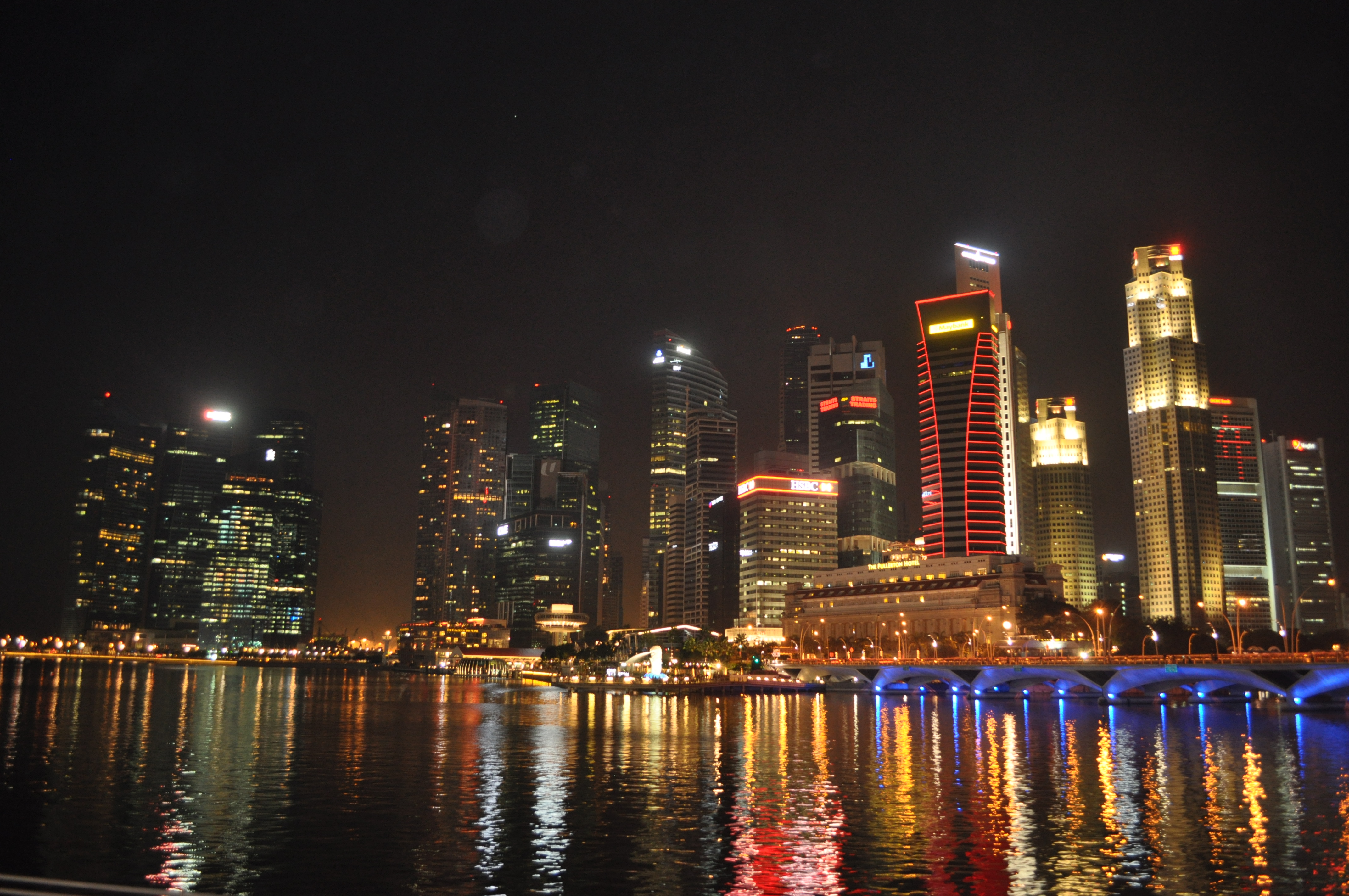
10 Architectural Wonders in Singapore

DSC_0653

1. Marina Bay Sands Hotel
DSC_0432

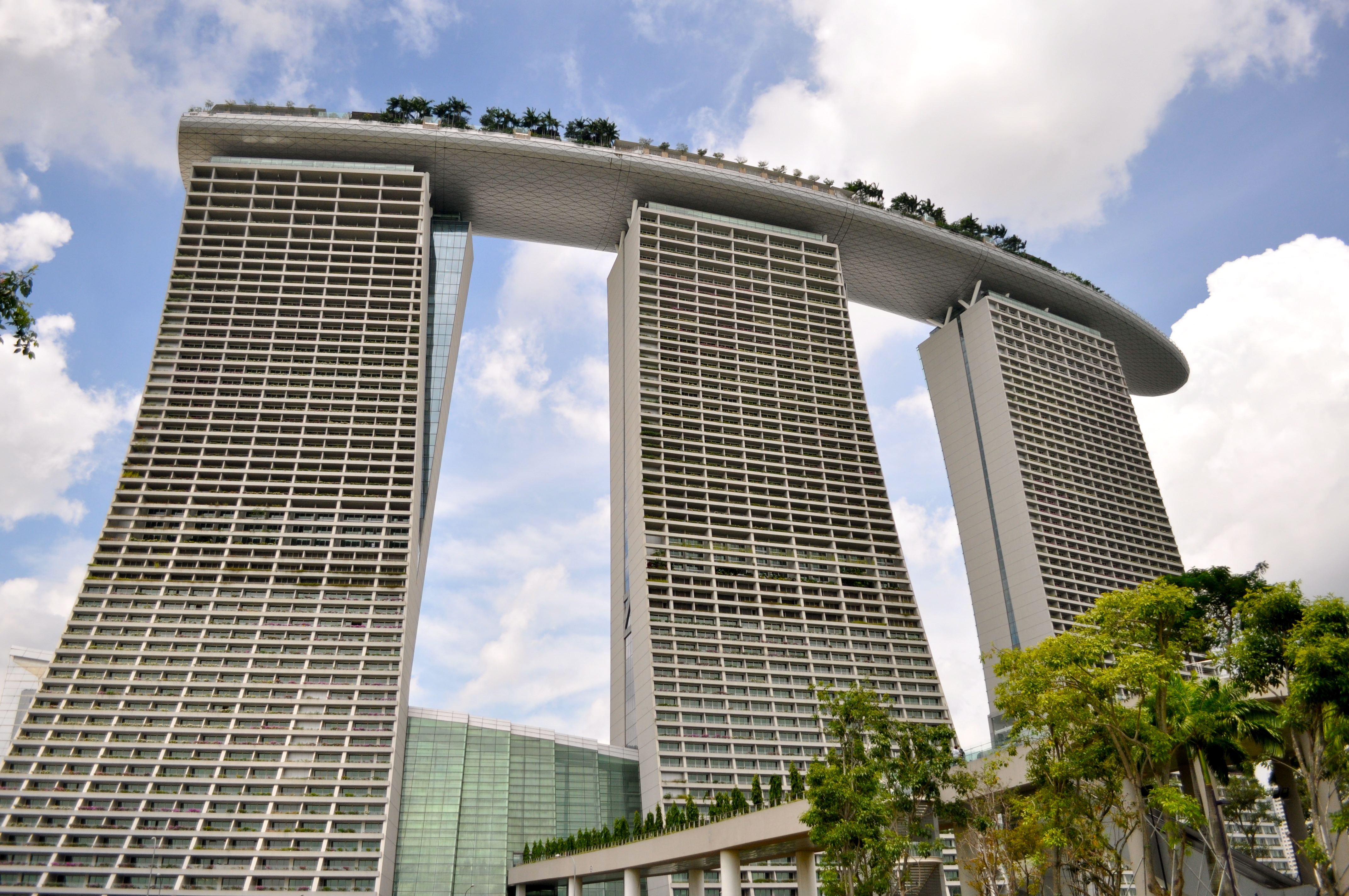
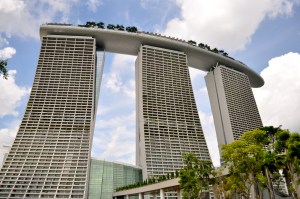
Possibly the biggest and most well-known chunk of the Singapore skyline, the Marina Bay Sands Hotel and Casino is made up of 3 towers with a giant boat-like structure joining them at the top (57th floor). On said floor, there’s an infinity pool overlooking the entire central district, a restaurant/chocolate bar, and the popular club, Ku De Ta. The ground level connects directly to the metro system and has it’s own shopping mall complete with gondola pond, skating rink, and food court. It’s the most expensive standalone casino property valued at $8 billion. It was designed by Israeli/Canadian architect, Moshe Safdie who says it’s design was inspired by card decks.

2. Helix Bridge

DSC_0272

Due to the fact that this bridge brings together science and design in one structure, it is one of my favorites. The helical bridge leads straight to the Marina Bay Sands Hotel and the Artscience Museum (how appropriate). Designed by Australian and Singaporean architects and engineers, it was opened in 2010. Although I didn’t get to see it up close when lit at night, I’ve read that it’s lit in alternating colors to represent the nitrogenous bases of the DNA double helix. Don’t you love the level of geek?

3. Esplanade
DSC_0235

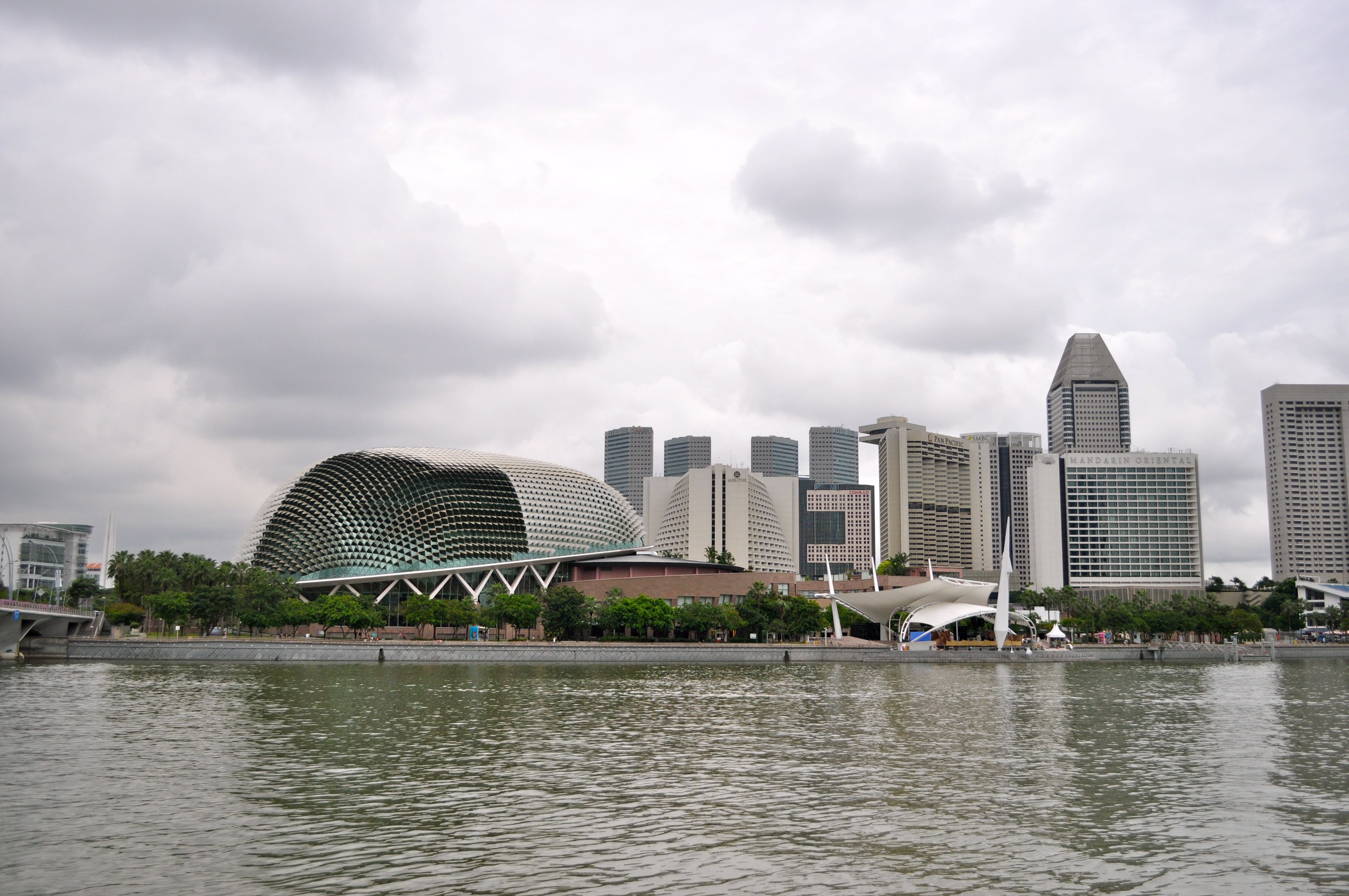
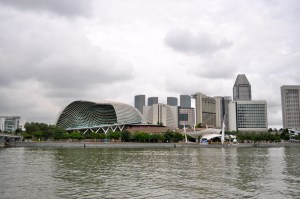
This center for theatre and the arts is located by the Bay and you can’t miss it because of one simple architectural detail: it looks like a huge durian. Now why anyone would want to design a building to look like the most vile smelling fruit on the planet is beyond me but it’s probably because the spiky organic grenade appearance is funky when applied to a gigantic 3D space. The building opened its doors in 2002, has triangular panels applied to its exterior, and is lit up at night – and no, it doesn’t smell.

4. Artscience Museum

DSC_0270

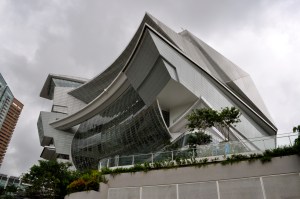
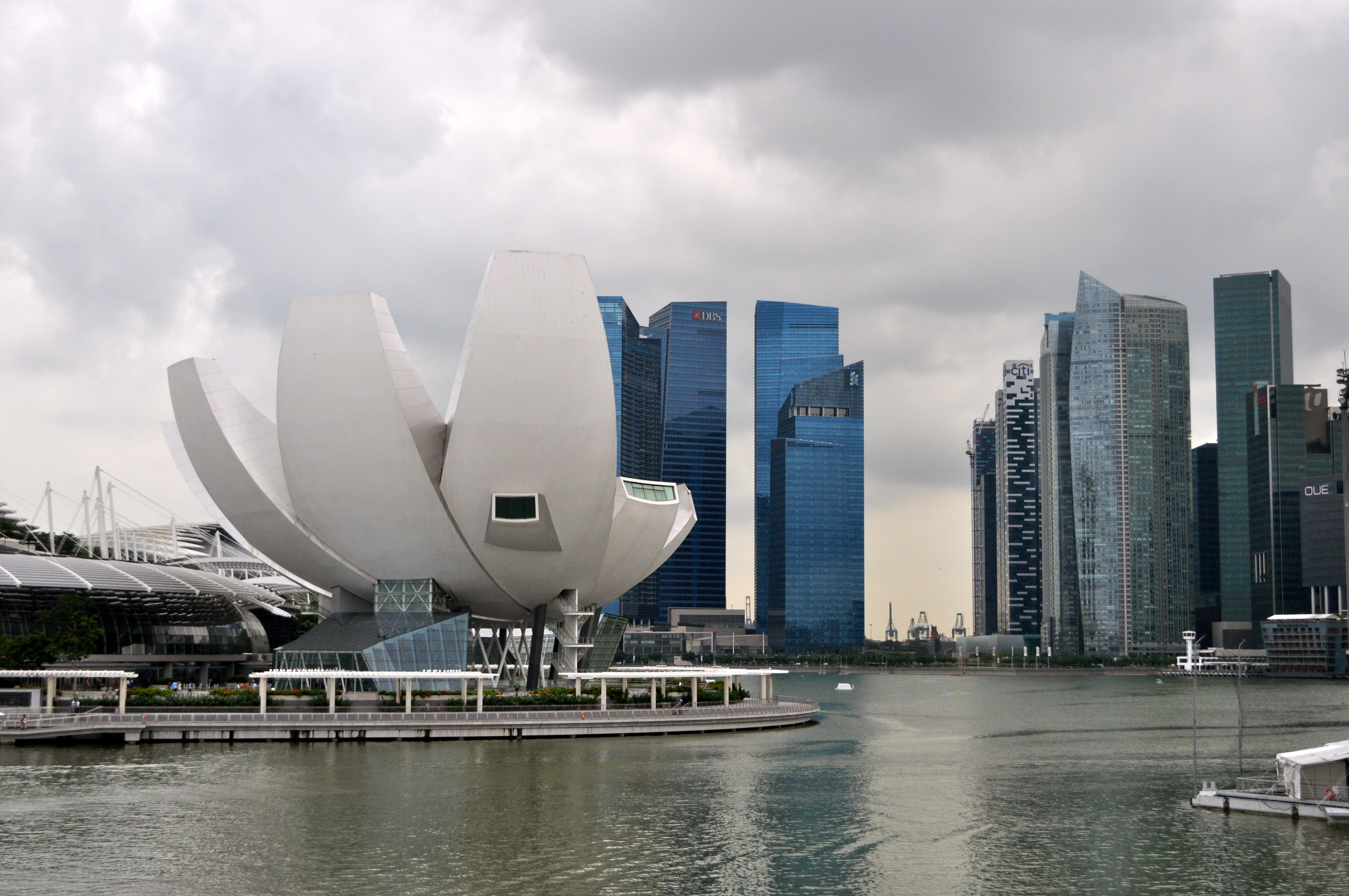
Also designed by Moshe Safdie, the museum’s shape is a blossoming lotus flower. It has 21 gallery spaces and usually hosts exhibitions that are shown at museums around the world. This February, they had the “Art of the Brick” exhibition for NY-based Lebanese artist, Nathan Sawaya. He builds sculptures using Lego pieces. There was also a photography exhibition that had a disposable camera under glass as if it were something sacred from the past. It seemed ridiculous but that didn’t stop me from feeling older than Maggie Smith.

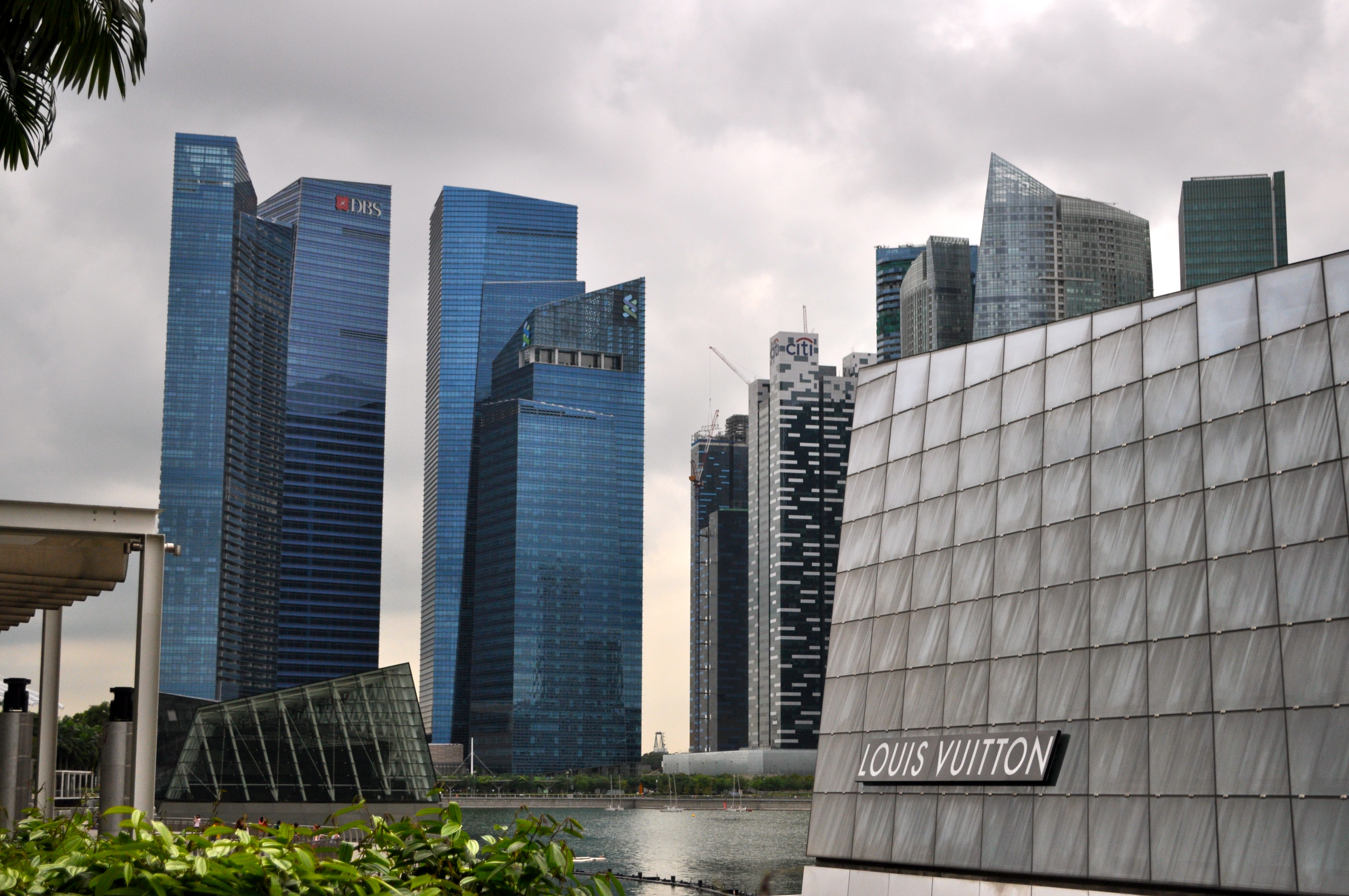
5. Louis Vuitton by the Bay
DSC_0284

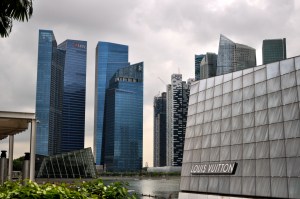
The LV Island Maison is a glass pavilion that sits on the water surface right outside the MBS hotel. The store has a nautical theme and resembles the Avalon, a club not too far down the strip that has a similar geometric glass box shape. It was a collaborative design by Moshe Safdie (again) and Peter Marino. The glass panels are fit with UV-resistant membranes so that the luxury goods inside are not affected. My picture doesn’t do it justice so watch this to see/learn more.

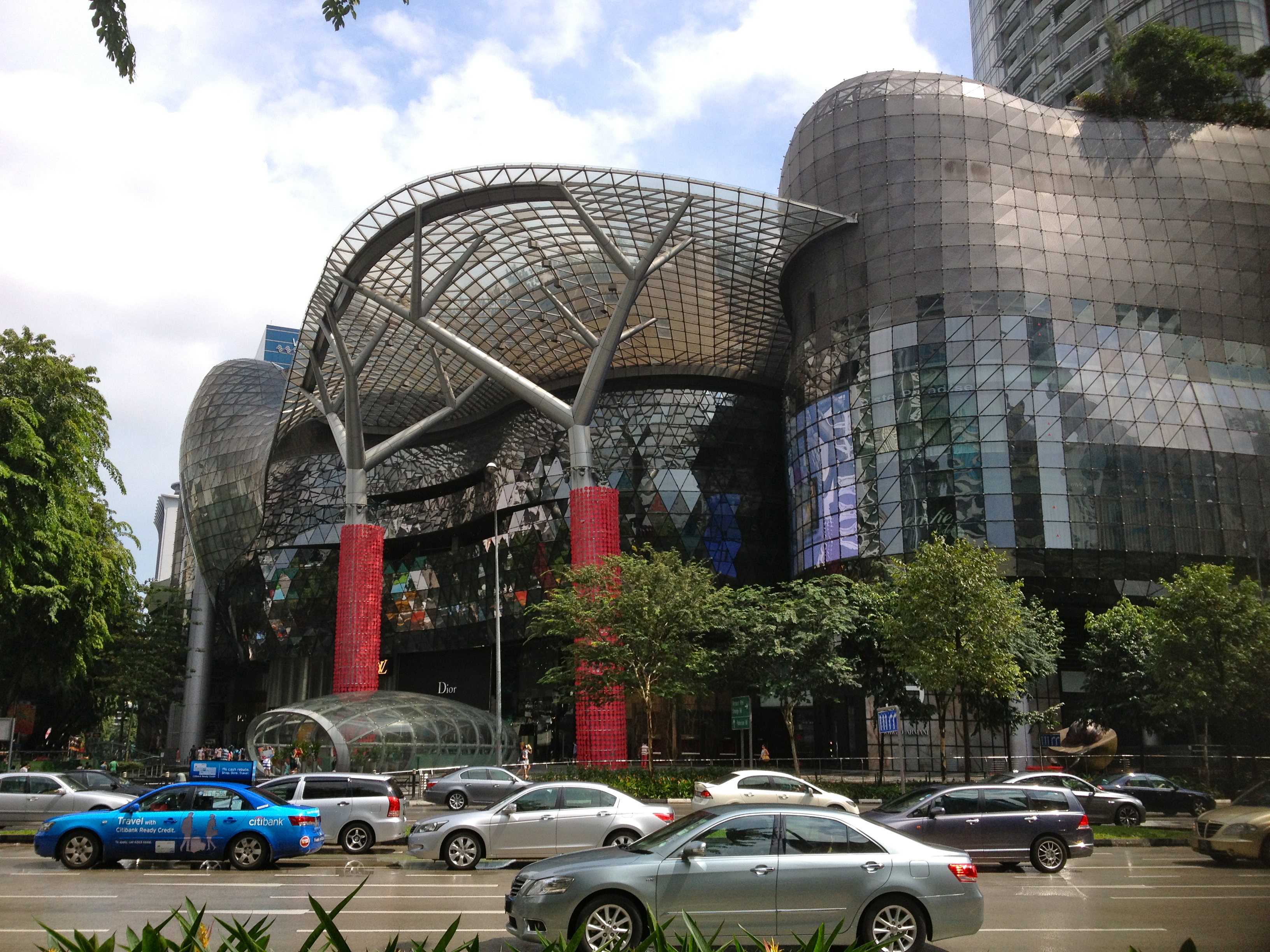
6. Ion Shopping Center

IMG_6314

Being one of many underground shopping malls located on Orchard Road, Ion was the first I went to – and the only one I kept going back to. It’s curvaceous glass exterior makes it seem quite other-worldly. Even the MRT station entrance (the bubble between the two red columns in the photo) looks like a teleportation system from Kubrick’s Space Odyssey. The first few floors, which are above ground, are high-end luxury retail shops. Those below are the more pocket-friendly. It’s sort of like the Titanic, the lower you go, the cheaper it is.

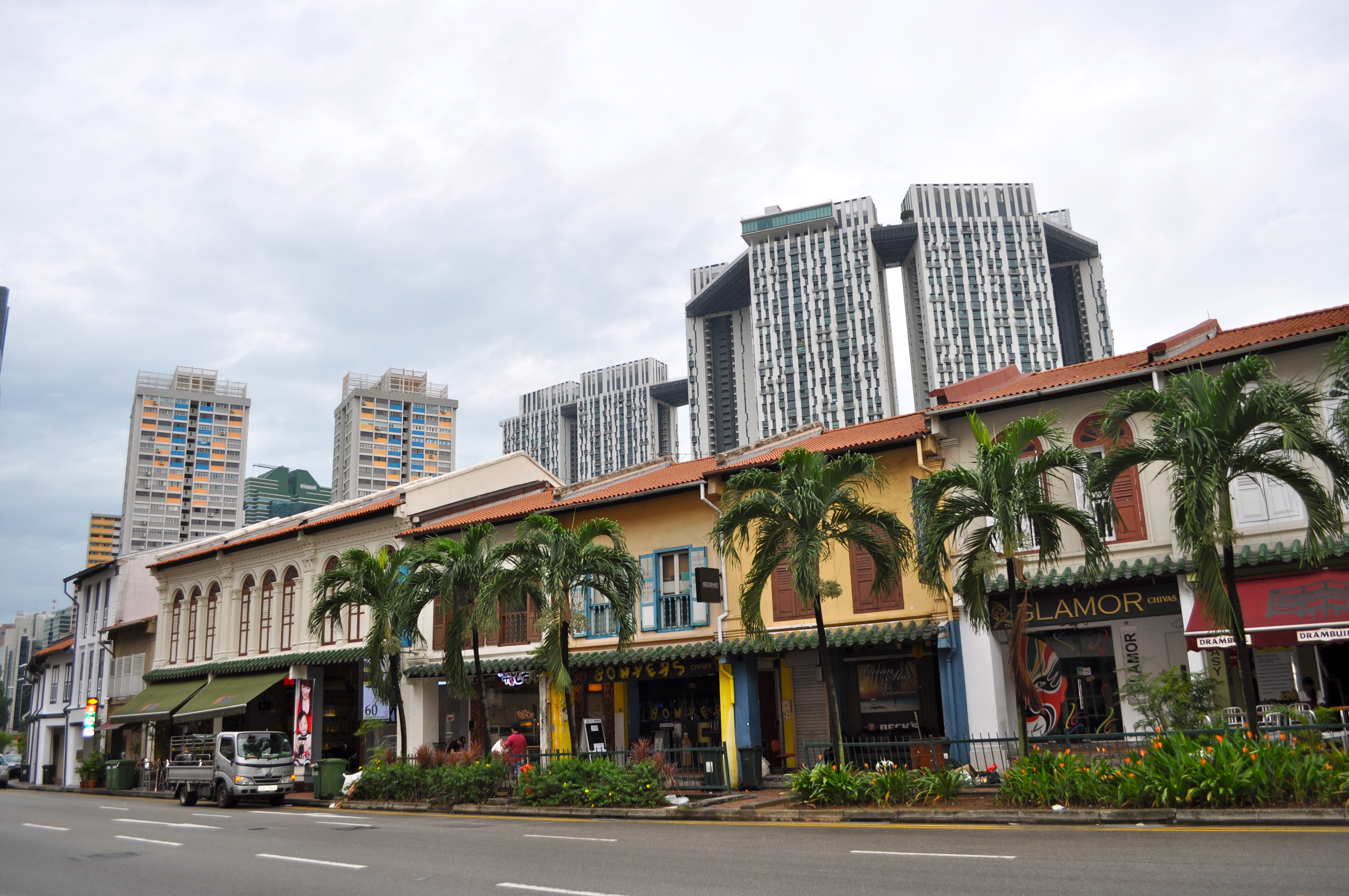
7. Colonial Buildings & HBDs

DSC_0569

A lot of the non-skyscraper architecture of SG dates back to the colonial period; there are lines of shophouses (imagine those townhouses on a typical San Francisco street) and black & white bungalows. According to Wiki, “In Singapore, they were built from the 19th century until World War II. The style incorporated elements of UK’s Arts and Crafts and Art Deco movements as well as the need of wealthy expatriate families for airy and spacious family homes. Black-and-Whites were built by wealthy families, the leading commercial firms and above all, the Public Works Department and the British Armed Forces.”

These old-style residences are usually up against the backdrop of towering HBDs (Housing and Development Board), which are complexes that are a form of low-cost state-built public housing. The most colorful HBDs I saw were found in the area between Bugis & Arab Street – they reminded me of the pink and yellow houses of Ashrafieh.

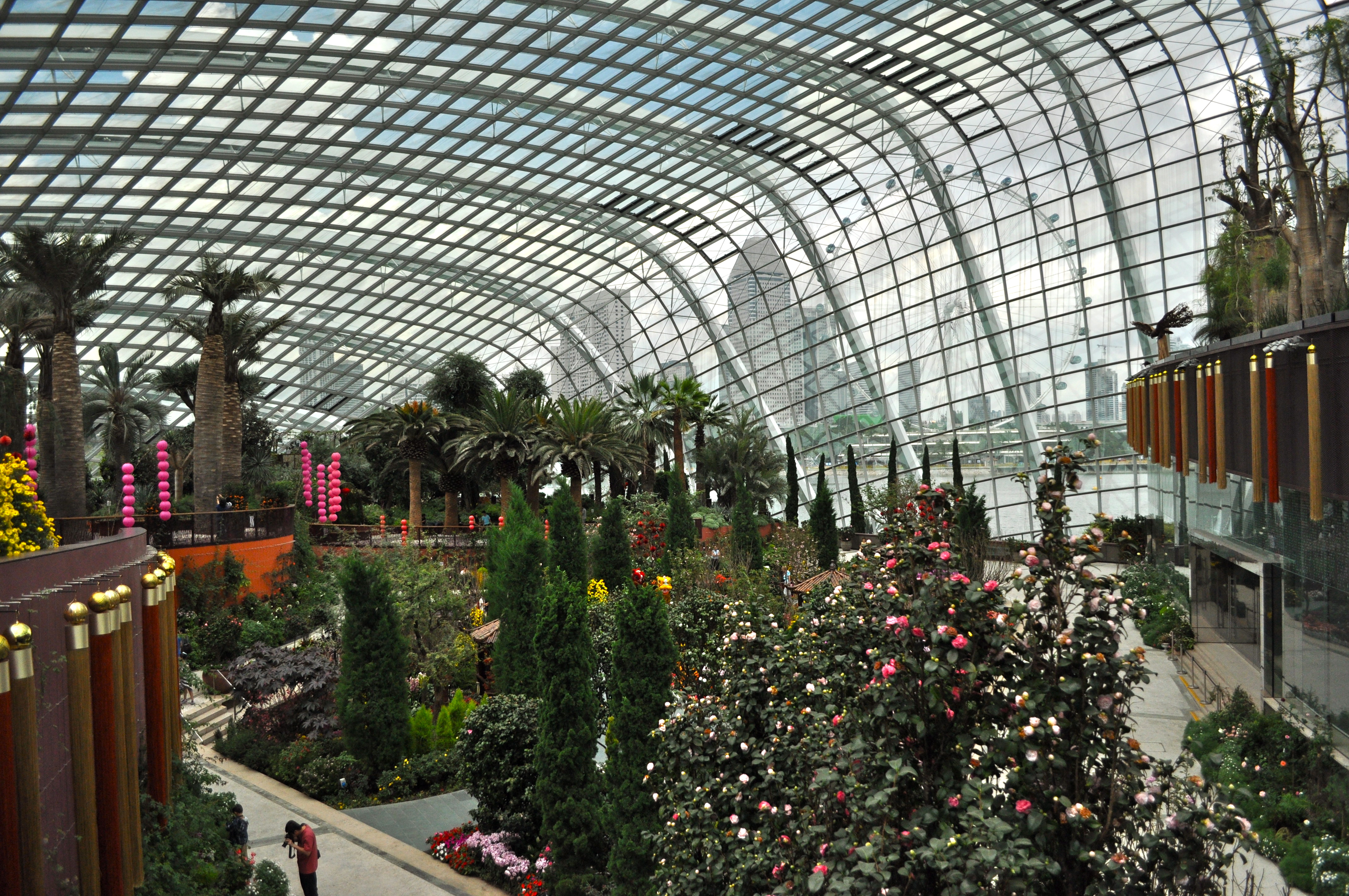
8. The Gardens by the Bay

DSC_0522

The two domes

DSC_0438

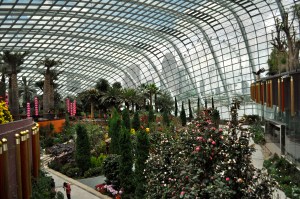
Inside the Flower Dome

DSC_0487

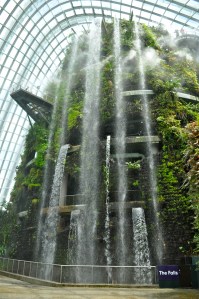
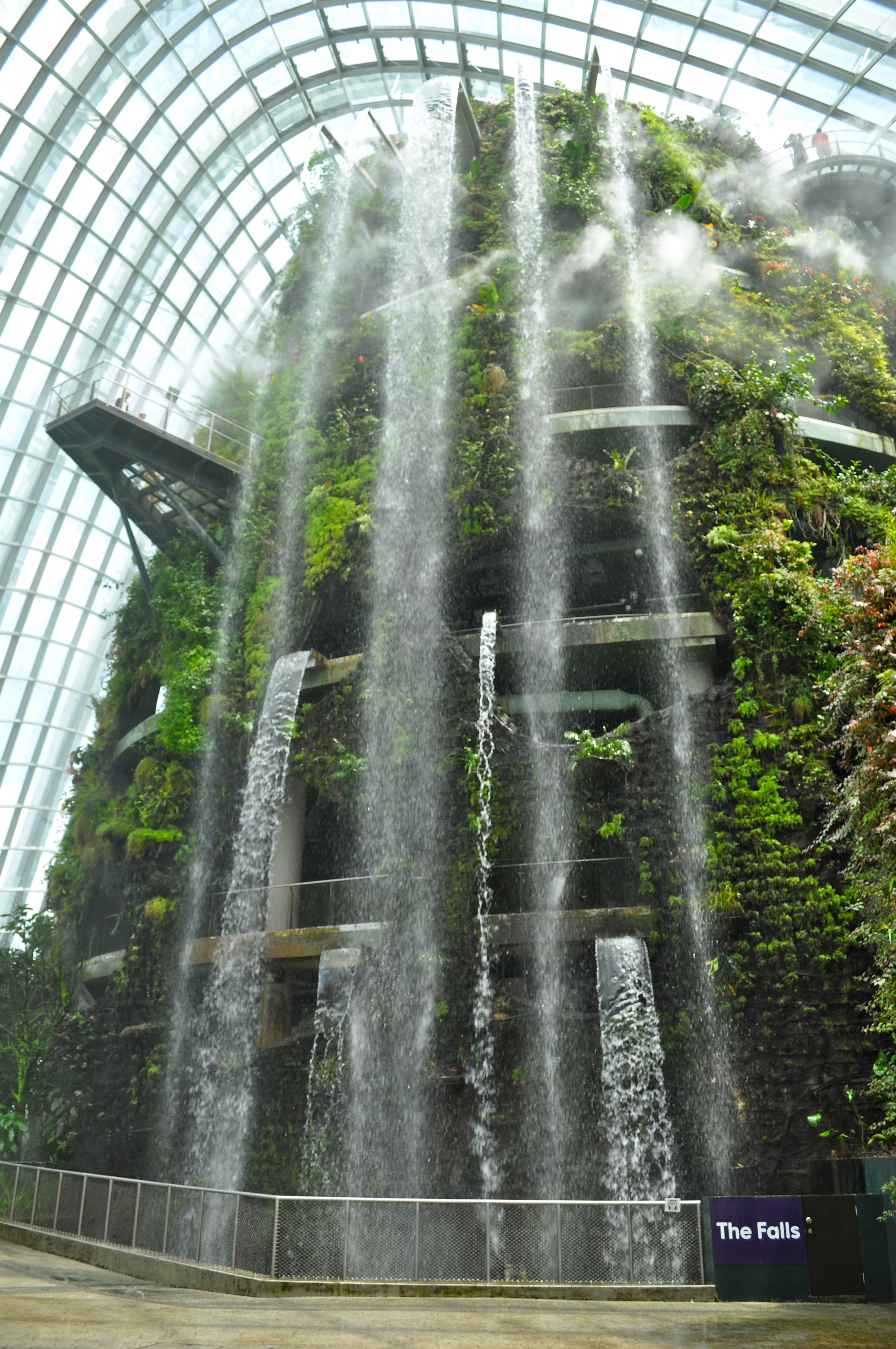
The Falls – inside The Cloud

DSC_0514

The mountain inside The Cloud

DSC_0523

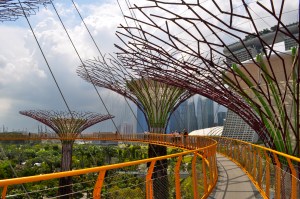
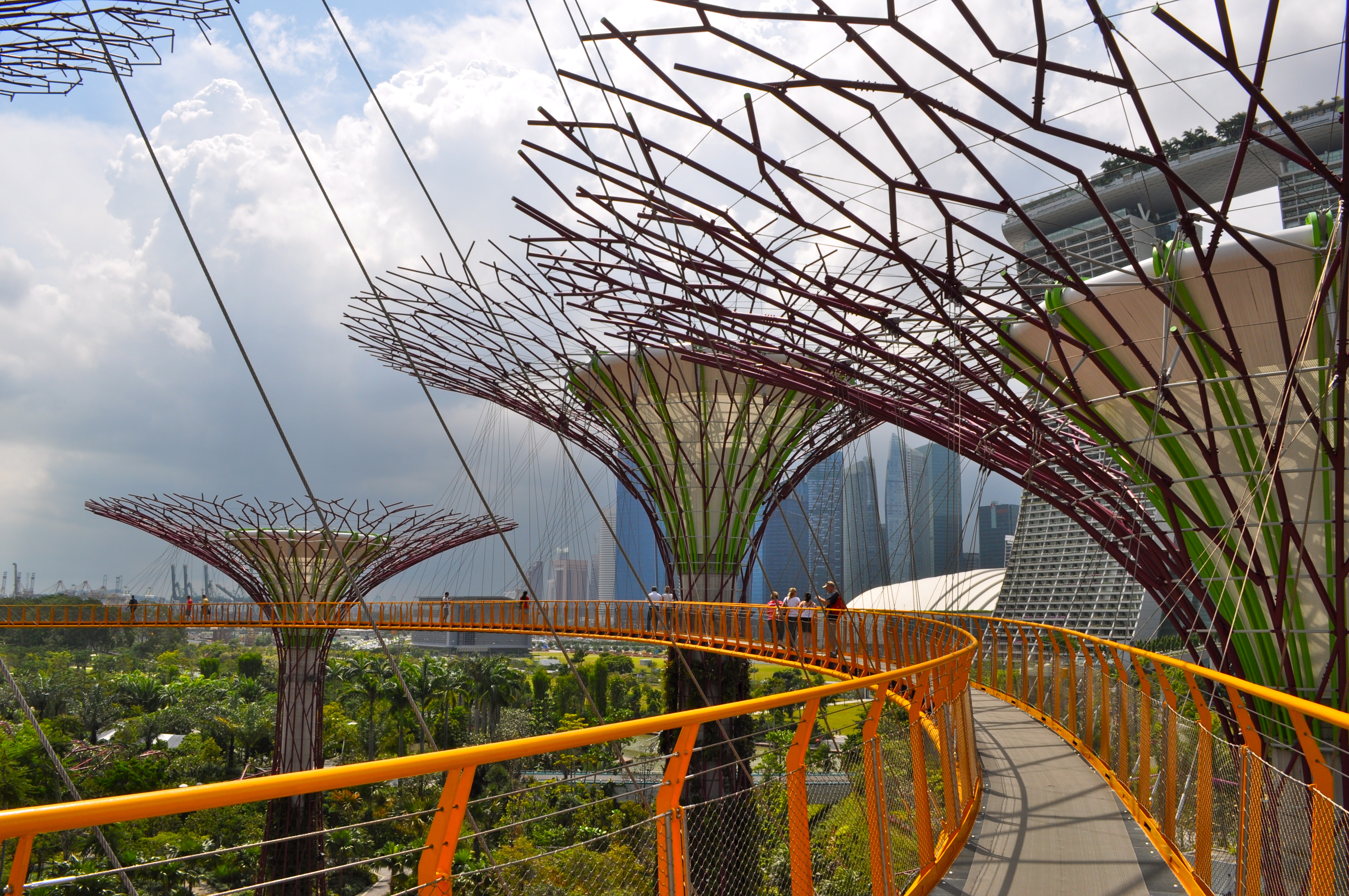
Taking a walk through the Supertrees

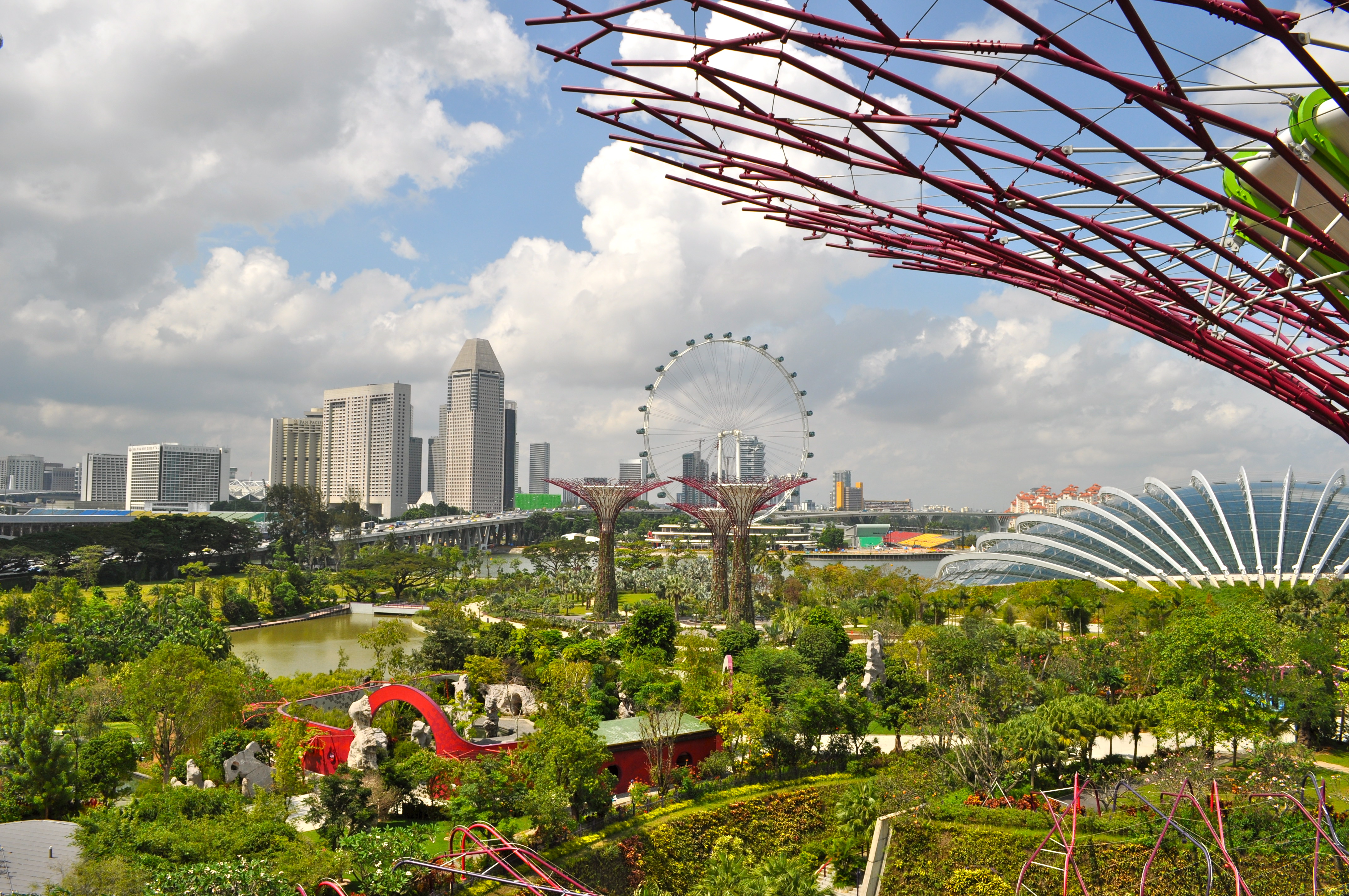
Recently opened in 2012, the 350 billion dollar project “Gardens by the Bay” is made up of two large domes, various gardens, and the Skyway. The two biodomes, The Flower Dome and The Cloud, house various species of flora within a temperature controlled environment. The Flower Dome has species from different parts of the planet divided based on geography/climate. The Cloud focuses on endangered flora that grow at higher altitudes – now at risk because of global warming. The Skyway is comprised of large tree canopies (also known as Supertrees) that are fitted with solar panels, hanging gardens, and rainwater catches. There’s a walkway that joins two of the trees so that you can walk across the 22-meter structures and take panoramic pictures of the gardens and the rest of the SG skyline.

9. Star Vista
DSC_0429 DSC_0430

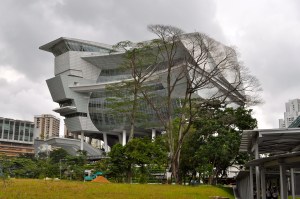
The Star Vista is another shopping/food plaza that also houses a large auditorium for shows. Located right outside the Buona Vista MRT exchange, it is one of the only shopping centers in SG without air conditioning. “The 15-storey mixed-development building keeps cool by optimising wind flow and air movement through open-air walkways and a 33m-high grand foyer that is not closed up so air can flow in. The shops, however, are air-conditioned.”  (source) The $976 million project was brought to life by American architect, Andrew Bromberg of Aedes architectural firm.

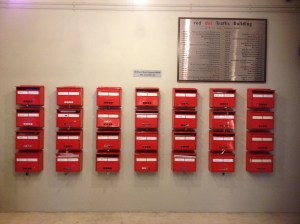
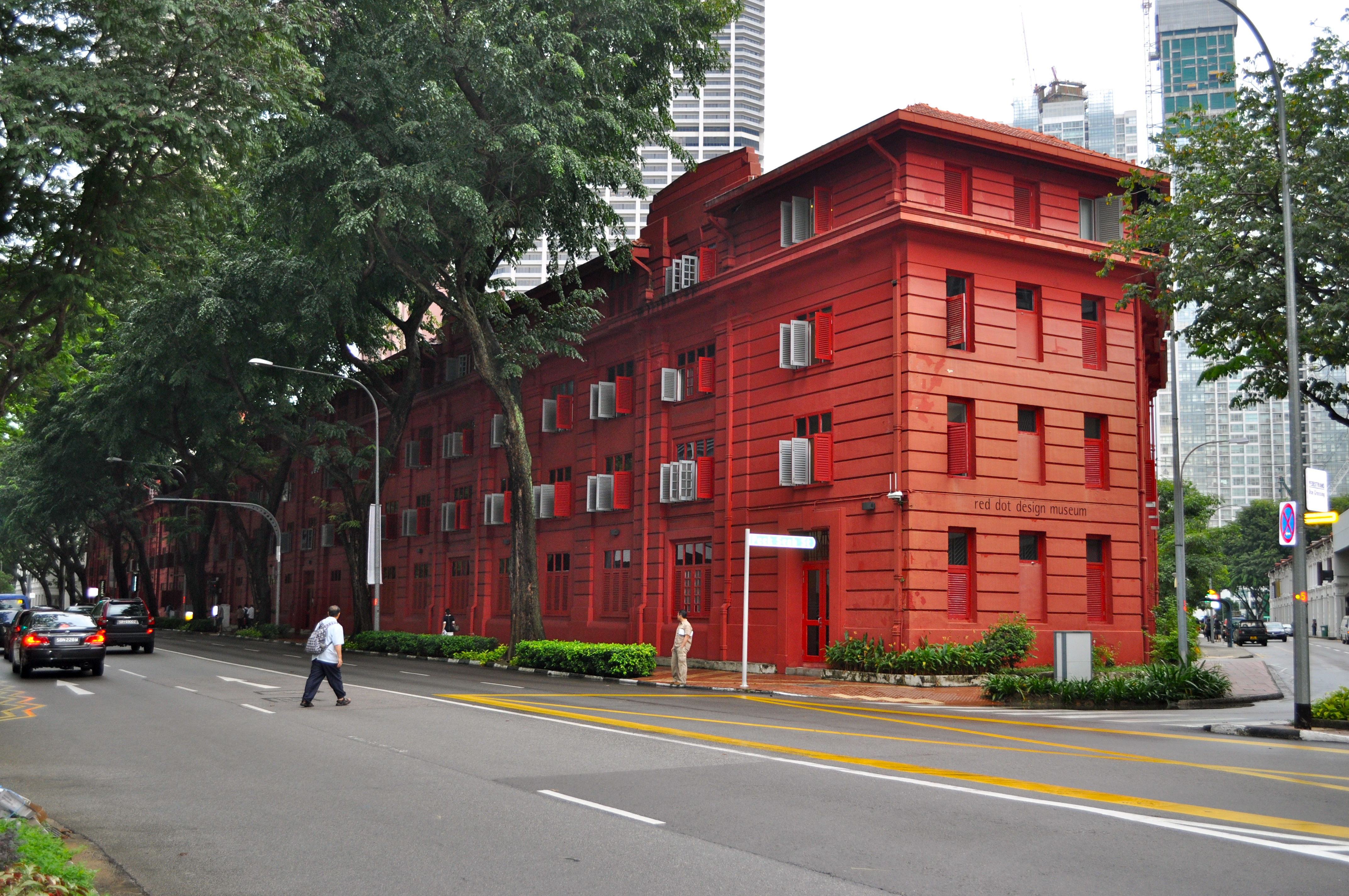
10. Red Dot Traffic Building

DSC_0537

IMG_6284

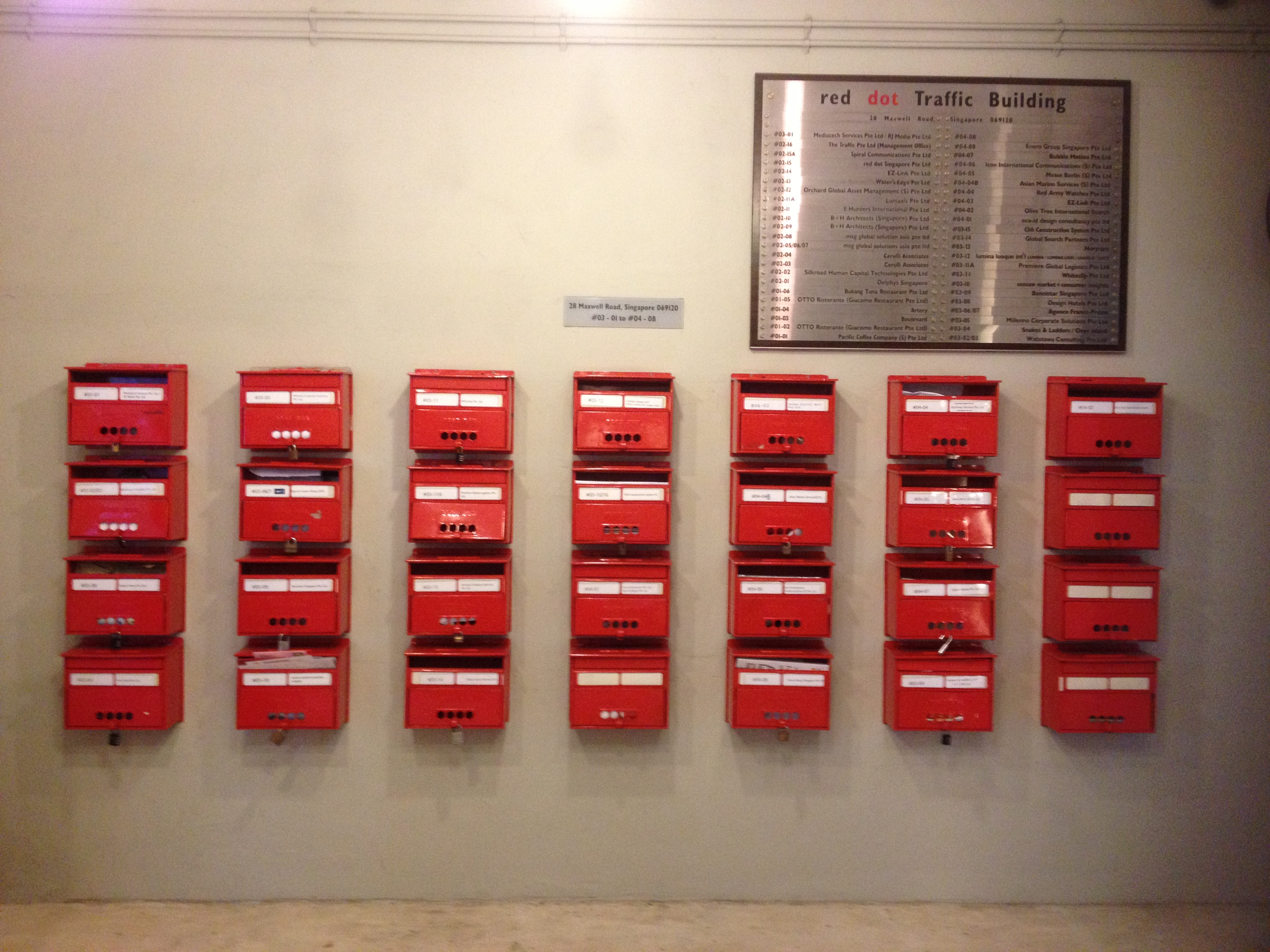
Pretty Red Mailboxes

What used to be a traffic police headquarters is now home to restaurants and the Red Dot Design Museum. It’s located on Maxwell Road, walking distance from the Maxwell Hawker Centre so you can have a plate of chicken rice after you’re done sifting through the winners of the Red Dot Design awards (entrance to the museum is S$8, S$4 for students). When at the food stall, make sure to get all the little tubs of sauces and be generous with the combination that you prefer. When it’s boiled chicken, we all know the truth: it’s all about the sauce.

Disclaimer: These are just a FEW of the many architectural wonders of SG. 
Between Singapore & Beirut

DSC_0525

DIFFERENCES

1.) Dress code

Although shopping is a daily activity in the life of a Singaporean resident, the dress code remains very chilled and casual. Unlike London, Paris, and Beirut, Singapore did not strike me as a place where people were very concerned with their daily attire. It’s more like the States in that it is perfectly okay to go to the supermarket in your pajama bottoms, wife-beater, and flip flops – and that’s without it being your “look” like the ensemble was intentionally chosen. It may be difficult due to the weather.

To make this clearer, in Beirut, you have around 5 basic levels of attire based on where you’re going that increase in snazziness gradually: Home/Teta, Work/Hamra/Uruguay St, Gemmayzeh, Clubbing, and Wedding. When in SG, I did not go higher than Level 2.

2.) Rules

There are so many rules and laws in SG that I was missing the chaotic corruption of Beirut (I got over it). Gum to SG is what pot is to Amsterdam in that you can have it but you can’t import it. Most travel to Amsterdam because you can order hash like it’s a non-hash hashbrown – or is it? Not exactly the same thing with gum in SG. You are not going to travel to SG just to chew gum because a.) it’s gum b.) unlike Amsterdam’s pot, it is not sold in stores and c.) people will give you disgusted looks while you blow bubbles and chew like a camel. What can I say, I’m graceful.

Besides gum, the people are also pretty strict on each other. There are websites where people tattle on each other for doing god-awful things like murals…which were commissioned by their own government. Fail.

3.) Alcohol

Unless you stick to local beer and whatever you managed to bring in from the duty free, booze in SG will cost you. Don’t worry, there’s Ladies Nights and affordable supermarket wine. In Beirut, you can have a good bunch of drinks for under $50, enjoy happy hours galore, or just go to Ahla A’lam and drink alcohol straight up out of plastic turkish coffee cups – if you survive, you’ll have a hangover for 48 hours.

4.) Public Transportation

SG has a subway system. And public buses. And cabs. And merlions that take you to school when it’s raining. Okay, that one’s not true but I wouldn’t be surprised if that happened by next year since they’re development projects come to life so quickly. I love any city that has a functioning subway – and every time I remember that Beirut doesn’t have one, I cry. On the inside. Of my car.

5.) Greenery

SG is actually a long lost jungle that happens to have roads and a metro. It’s not even a joke. You can be sitting having a club sandwich at a cafe in the middle of a rainforest except it’s not the Rainforest Cafe, you’re just in the middle of the Asian Amazon. Some of the most visited attractions are tributes to plantlife and flowers like the Gardens by the Bay and the Singapore Botanic Gardens. On the other hand, the greenest area in Beirut would be the AUB campus or the ABC parking lot at 9 am. Yes, I mean the parking sensors.

SIMILARITIES

1.) Rooftop Bars

Perhaps because the central district has such a great view, SG rooftop bars are popular but not practical. Unpredictable rain doesn’t help outdoor terraces but the drizzle doesn’t stop anyone from taking it all in anyway. Without mentioning music preferences and ambiance, the better weather and cheaper alcohol may put Beirut ahead of SG in this category.

2.) Religious Melting Pot

Pagodas and Hindu temples are the equivalent to Beirut’s collection of churches and mosques. Buddhism, Christianity, Hinduism, Islam – there’s a whole mix of sects too. Sound familiar? Yay, three cheers for coexistence!

3.) Actual Melting Pot

Food tourism is a big similarity. In SG, you have the choice to eat from all kinds of Asian cuisine: Thai, Indonesian, Chinese, Malay, Japanese, Indian – there’s even a large selection of Western chains including California Pizza Kitchen and The Cut by Wolfgang Puck. If you’re not too adventurous, you can have the Teppanyaki Chicken Sandwich from McDonald’s – just a small dose of Asian on top of a chicken burger you’re used to. Beirut has the same array of food to choose from with a complete set of Mediterranean deliciousness. No CPK or Puck here yet, but we do have Gaucho and Le Relais de l’Entrecote. Even Asian is taking over in a not-just-sushi-way; however, I still would prefer a whole bowl of tabbouli over a wok of stir-fry. Represent.

4.) Compared to Dubai

Much like Beirut, Singapore has been compared to the city of Dubai except that their comparison is more accurate. Singapore went from an infertile island with no natural resources into a “highly developed Asian megalopolis”; a lot like the city that rose from the sands in the Emirates. A colleague of mine once said that if you visit Dubai, the skyline looks as if someone copied the outline of Singapore and pasted it in the Arab world. Regardless of how true that is, both have been artificially constructed to some extent – how much? I can’t say for I have yet to go to Dubai.

5.) Size Doesn’t Matter

Singapore and Beirut are both ridiculously tiny but that just goes to show that kilometers are just numbers; it’s how you use them that makes all the difference.

10 Fun Facts about Singy/S’pore/SG

IMG_6088

Singapore, in my mind, can be summed up in 3 words: green, clean, and Asian- although I was told repeatedly that Singapore was the most westernized Asian destination. Still, as an Arab who had never been anywhere past the Middle East when it came to Asia, Singapore was very different than any other city I had experienced as a tourist.
1.) You can drink from the tap and perhaps my stomach is tough but I survived it – and if you do order a drink, ask for lime juice. Instead of being a sour mix of green like you’d expect, it’s a light tangy refreshment. One place in Chinatown called G7, known for its bullfrog porridge, had particularly sweet orange-colored lime juice. Alcohol is very expensive so stock up on a few bottles from the duty free upon arrival – but beware, there are restrictions as to how much alcohol you can buy upon entry. Specific combinations are as follows: 1 pack of beer, 1 wine bottle, 1 bottle of spirits or 2 bottles of wine and 1 pack of beer or only 2 packs of beer. Drug trafficking will get you the death penalty so keep it clean.

2.) Rain boots are futile. It’s the first time I ever walked through puddles in sandals, complained about the heat in the middle of a thunderstorm, and felt fluffier than a freshly permed chia pet – all during the month of February. Being so close to the equator means that Singapore is tropical year-round, and wet all the time. And that’s what she said.

3.) Cab drivers, who are also called “uncle”, don’t know their way around the city-state, which is only 274 square miles, and insist that you tell them how to get to where you’re going. God help you if you don’t know where that is…which is the case for most tourists on the planet. They are not the best drivers – there were some close calls with a few BUSES. Their music fluctuates and is in any language: one lady driver was cruising to a melody that sounded like the Chinese Wizard of Oz soundtrack whereas my driver to the airport, Mr. Boo, was grooving to Spice Girls. And drivers sit in the right seat – it’s all quite British except that you’re in Asia. You don’t need cabs – the metro and the buses are enough to get around if you’re not out too late. Bring something to read though because some transits can be long rides. Unlike London where passengers were all buried in books or newspapers, Singy locals are all glued to their devices probably due to there being cellular reception underground.

4.) Like most things that would be antiestablishment and/or illegal in Singy, street art is virtually nonexistent. The street art that does exist isn’t real street art since its commissioned by the government. The biggest form of creative public intervention seen were some stickers and one phrase on a wall on Arab street.

5.) Most malls are underground. Connected through the metro and having the luxury brand names on the ground level, malls run deep in the earth and are also interconnected with each other. Consumerism is a huge part of Singapore – seeing that the average resident has a high salary, they have plenty to spare on goods and the schizophrenic weather keeps them indoors long enough that there’s only one place to go on a rainy day: the mall. There are mini malls in between metro stations and a giant maze of shopping centers on Orchard Road. I think I saw 4 Louis Vuittons in a stretch of 1 mile.

6.) Street markets and food centers (hawker centers) are something we are missing out on – offering cheap goods, clothing, and food. The street markets in every country must have the same source supplier given that I have items I’ve bought from the UK and France that popped up in Singapore’s Chinatown and Bugis. Sure, they’re probably bad quality (but who cares at S$10/piece) and the chicken rice may give you salmonella poisoning but what’s travel without a little adventure and germs? If it makes you feel better, Anthony Bourdain visited a few but, then again, that guy eats everything. Regardless, food stalls are graded in cleanliness and have a big range of dishes from all around the region. I preferred murtabak which I was told was Malaysian but upon a quick search, it seems it’s Arab – no wonder I liked it. Just pour chili sauce on whatever you’re eating and it’ll taste good, no joke. Besides the spice, get some honey banana fritters for dessert.

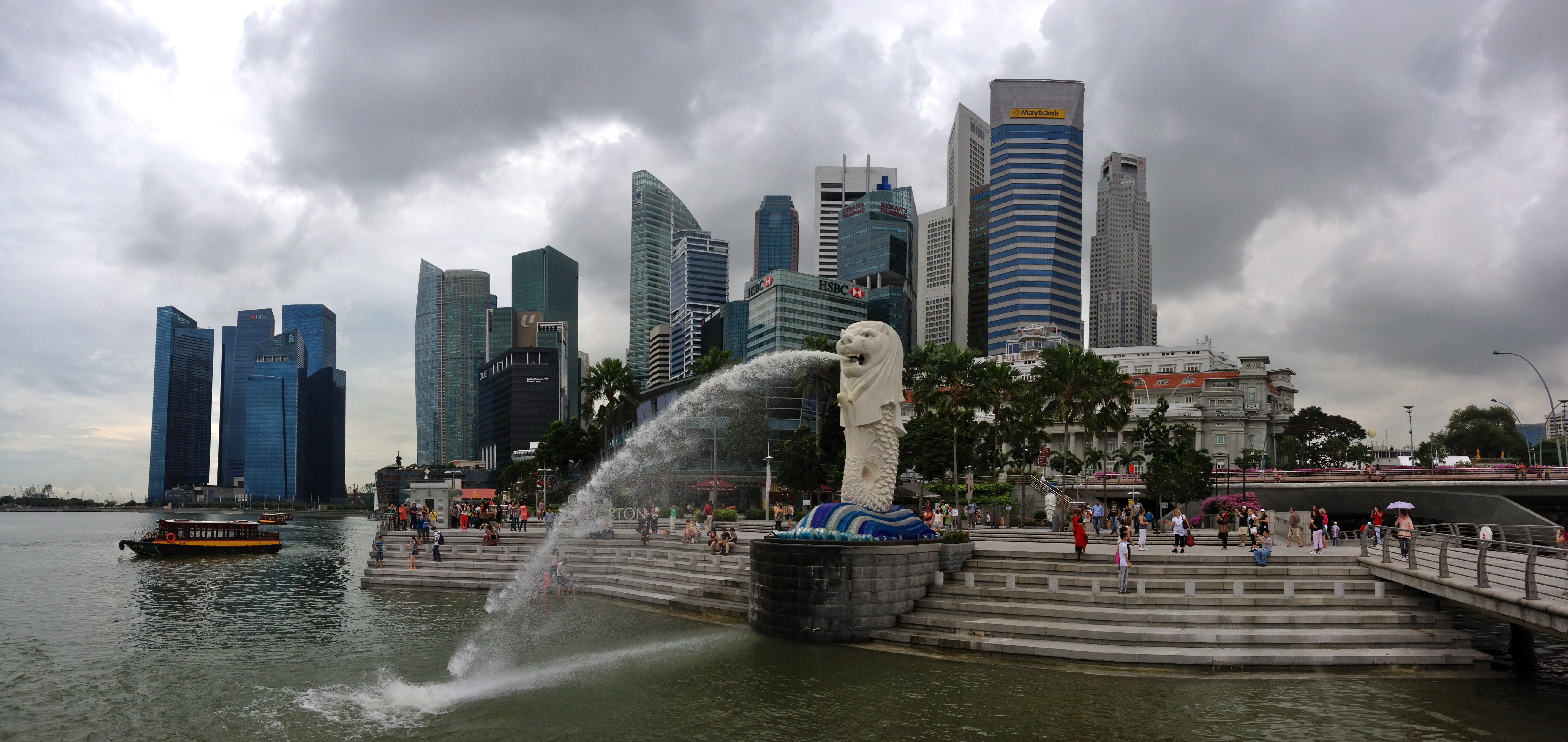
7.) Tiger Beer, Tiger Balm, and the Merlion – 3 things that I associate with Singapore now: the first two are born in the country. Tiger beer, started in 1932, is light and doesn’t give you that beer-belly feeling. Fans of Almaza may not think it’s “real beer”; I liked it but I also like margaritas and Baileys. Just saying, I’m not much of a hardcore drinker. The Merlion is a signature of Singapore  because “Singapore” means “Lion’s City” in Sanskrit and the mythical creature was used to symbolize the city by combining it’s name with it’s past: a small fishing village. It’s now Singapore’s mascot around the world thanks to the statue that sits at the Marina Bay.

8.) Mustafa Center – located in Little India, it’s pretty much a shopping center that could be a small city. This place has merchandise, a pharmacy, a fresh produce grocery, a giant money exchange, and a restaurant on the roof. It has everything from “Sexfuel” pills to London souvenirs. Yeah, I don’t know why either.

9.) When giving you change and your receipt, they use both hands and you are expected to receive it with both hands as well.

10.) You’re not allowed to eat or drink on the metro or the bus but there are plenty of restaurants and 7/11s in between stations to grab quick bites. Bread Talk for some pork floss? Prawn balls, curry pockets, or maybe just some French fries from McDonald’s with chili sauce? If you’re not a big fan of Asian cuisine, there’s a bunch of Western spots and a Starbucks every 10 paces. Or just pop in to any Indian joint and fill up on garlic naan while waiting for tandoori chicken (practically like a farooj). Or have some dosai with masala potatoes dipped in an array of sauces. Or hazelnut crumb brownies from Awfully Chocolate. Really, food’s not an issue – you’ll find something.

But whatever you do, stay away from the durians.

Tiger Balm Disneyland

DSC_0382

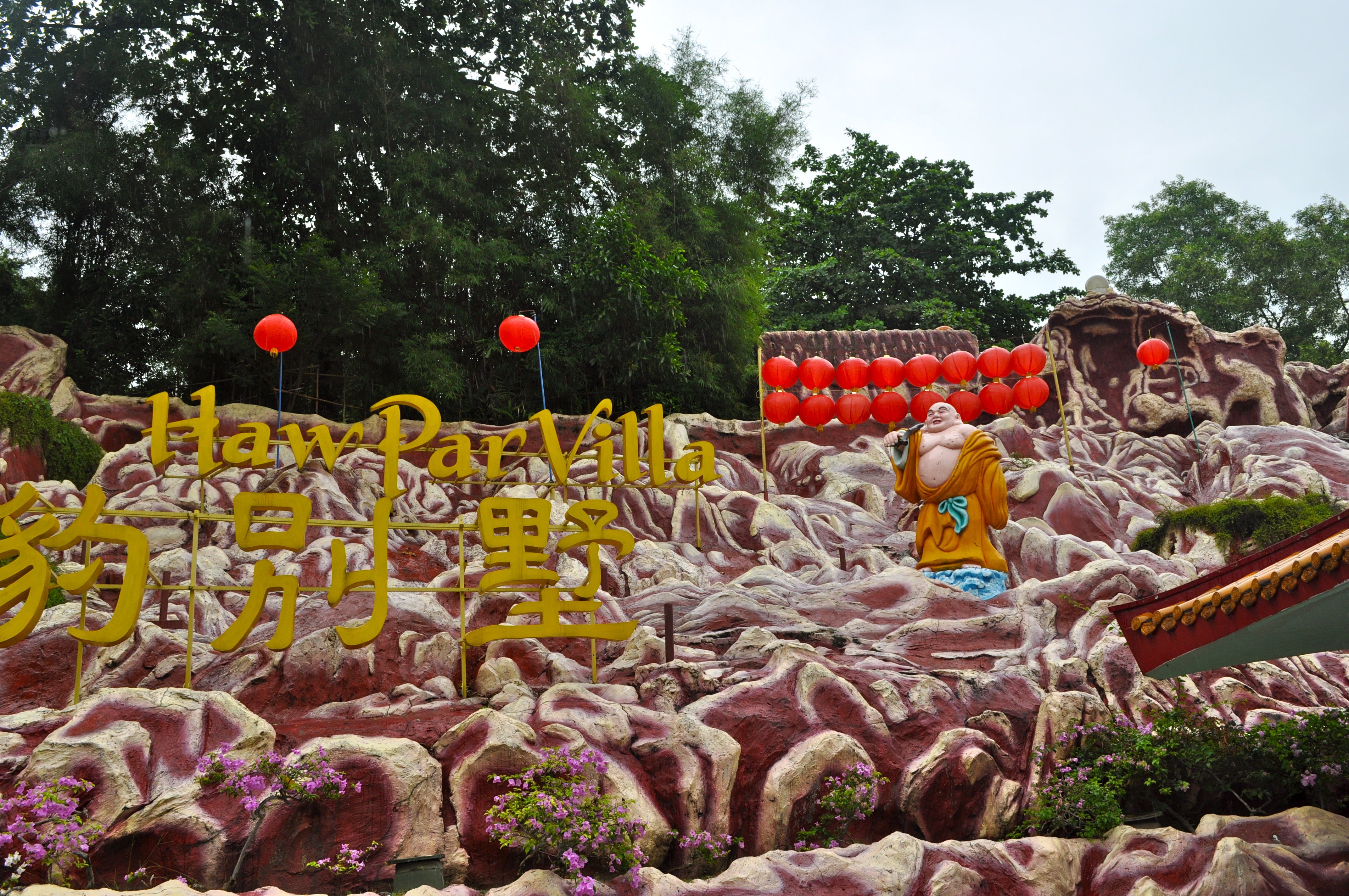
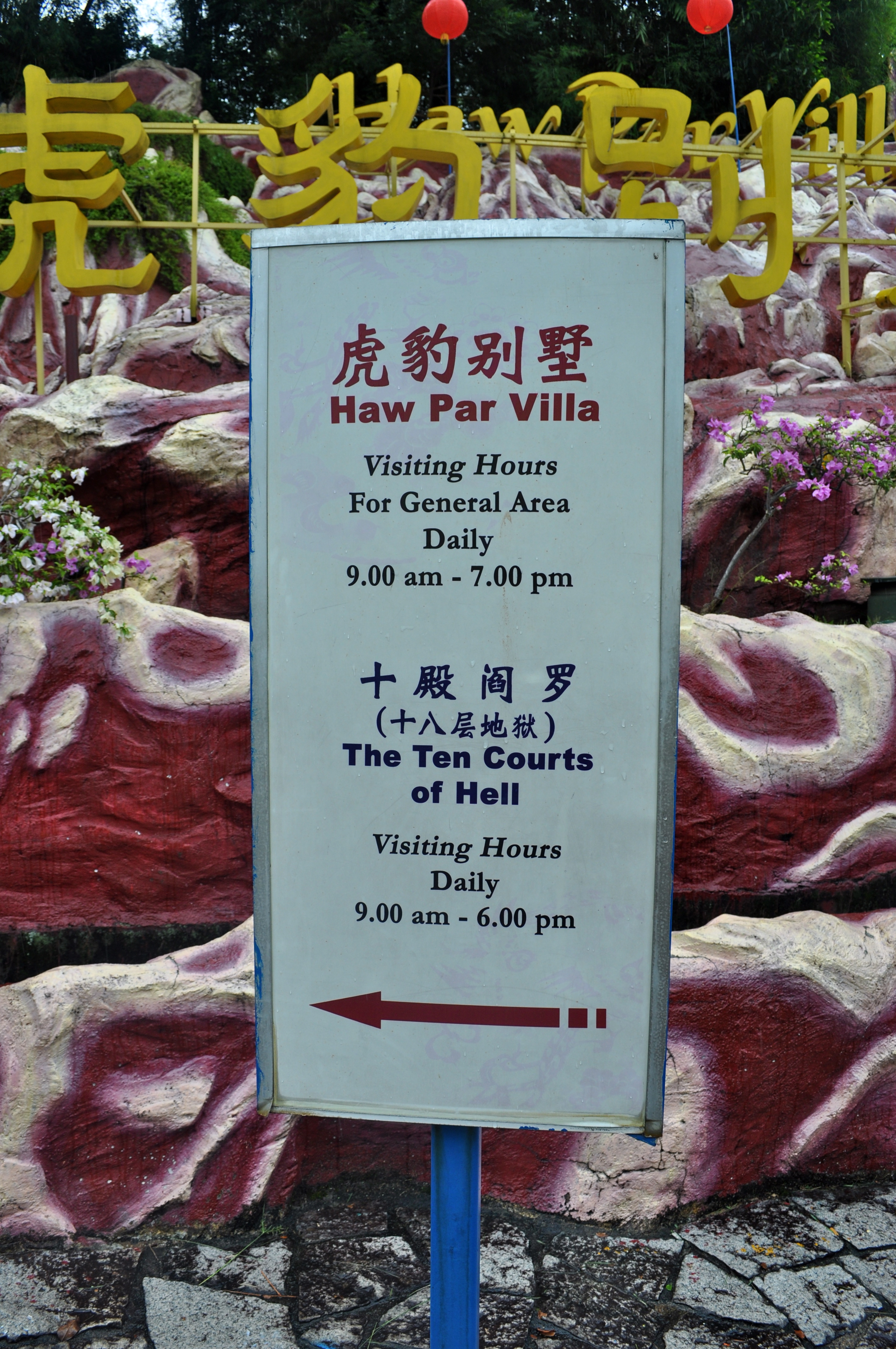
Haw Par Villa, or as I came to think of it “Moussa’s Castle for Crazies”, is an abandoned theme park located in Singapore. Locals call it “Chinese Disneyland” and foreign residents call it “Creepyland” for this place is the exact dilapidated nightmare you would imagine when thinking up a spooky ride based on Chinese folklore with brightly painted figurines.

DSC_0391

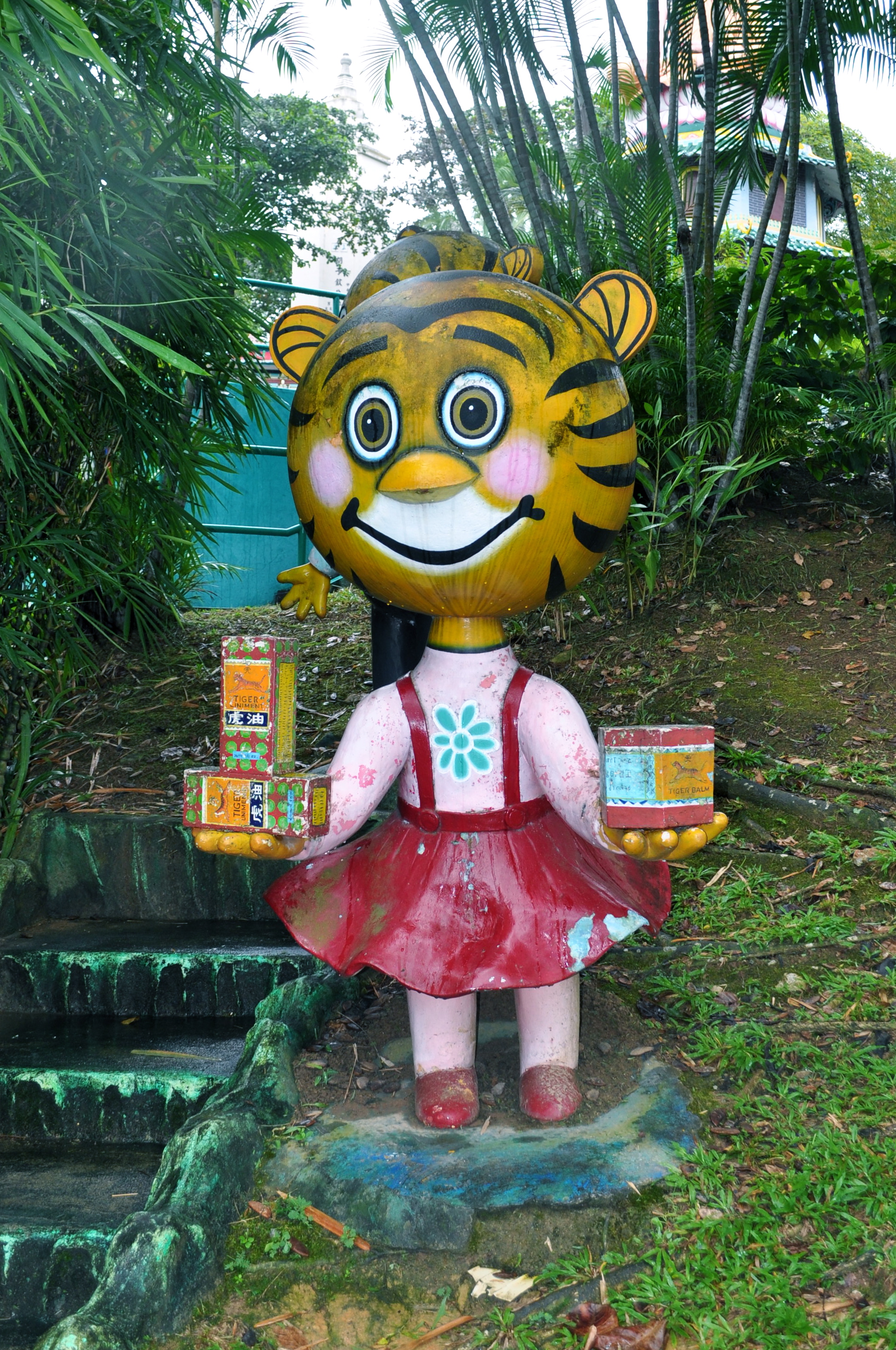
Formerly known as the “Gardens of Tiger Balm”, Haw Par Villa is named after the Burmese brothers Aw Boon Haw and Aw Boon Par. They were manufacturers of the famous Tiger Balm – or as us Arabs know it: “Abu Feis.” Their graves are also in the middle of the park in giant phallic beige stone structures.

Side note: Tiger balm is some pretty magical stuff- it smells like Vicks Vaporub and is great for mosquito bites, which is handy because Singaporean mosquitoes are silent non-buzzing sneaky mofos that can give you Dengue fever.

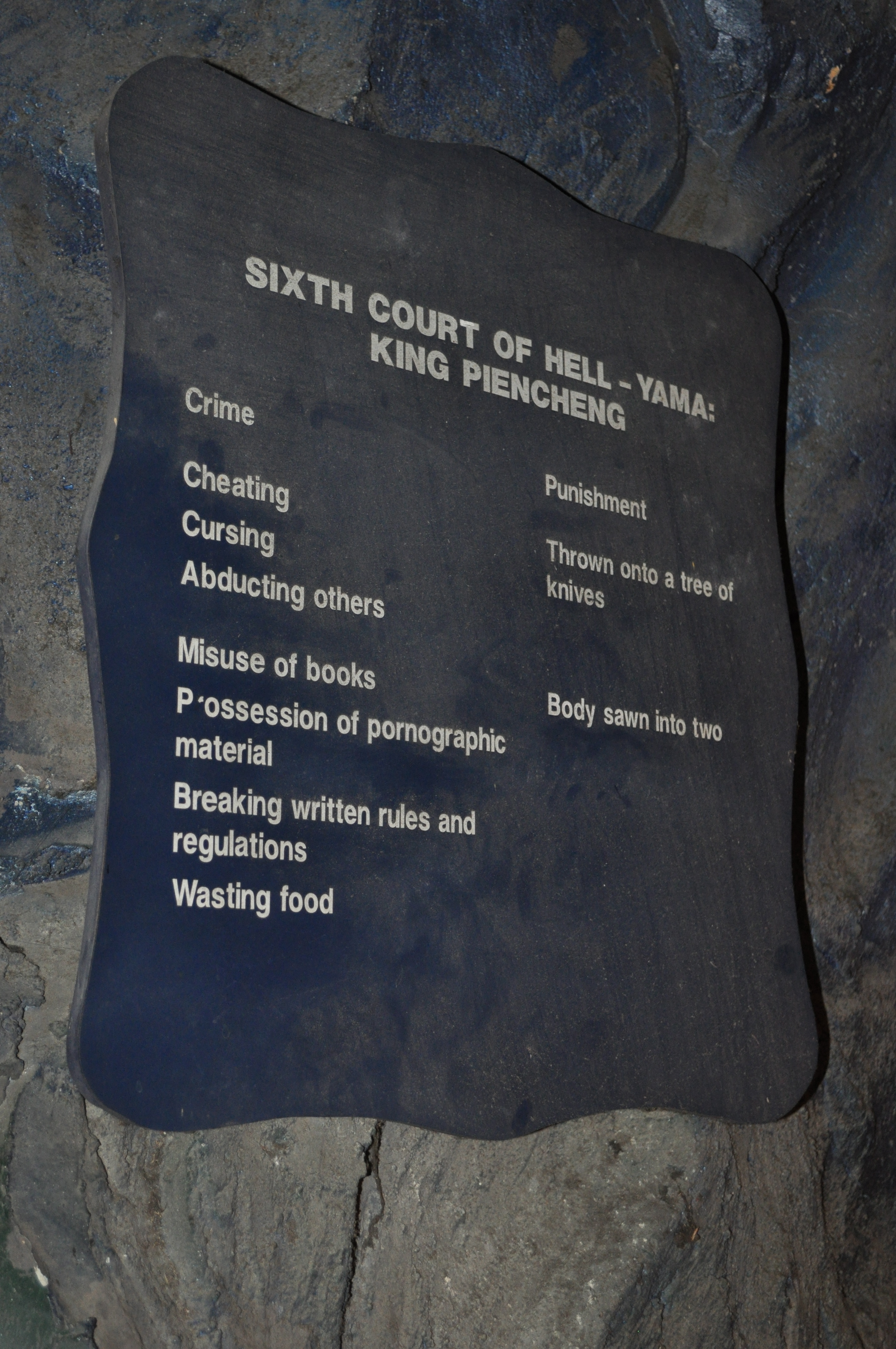
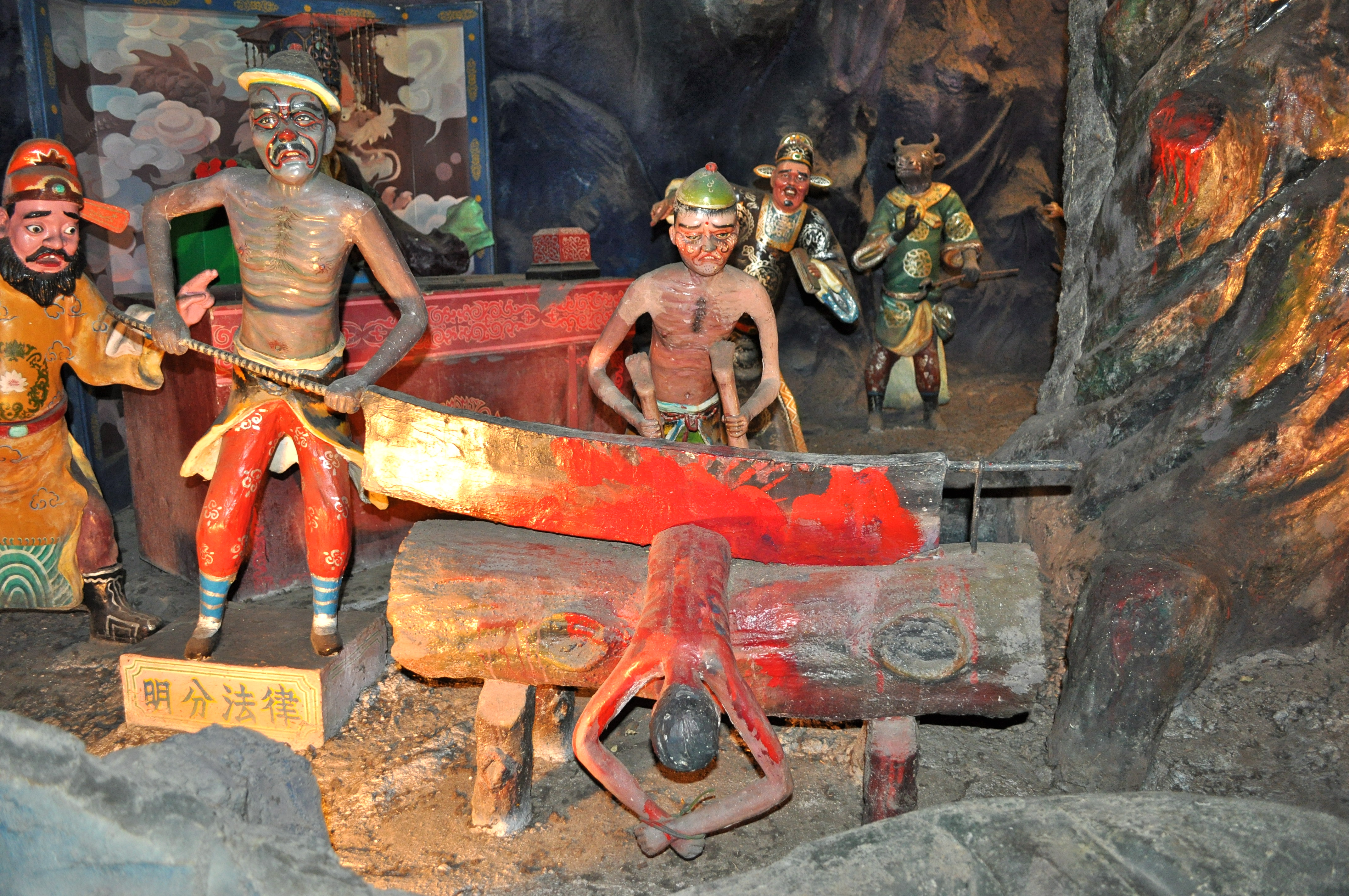
Although Moussa’s Castle’s history is somewhat more dreamy and romantic, Haw Par Villa revolves around legends and Confucianism beliefs. The one section that is the most – let’s go with “captivating”- is the part of the park that is dedicated to the Ten Courts of Hell.

DSC_0384

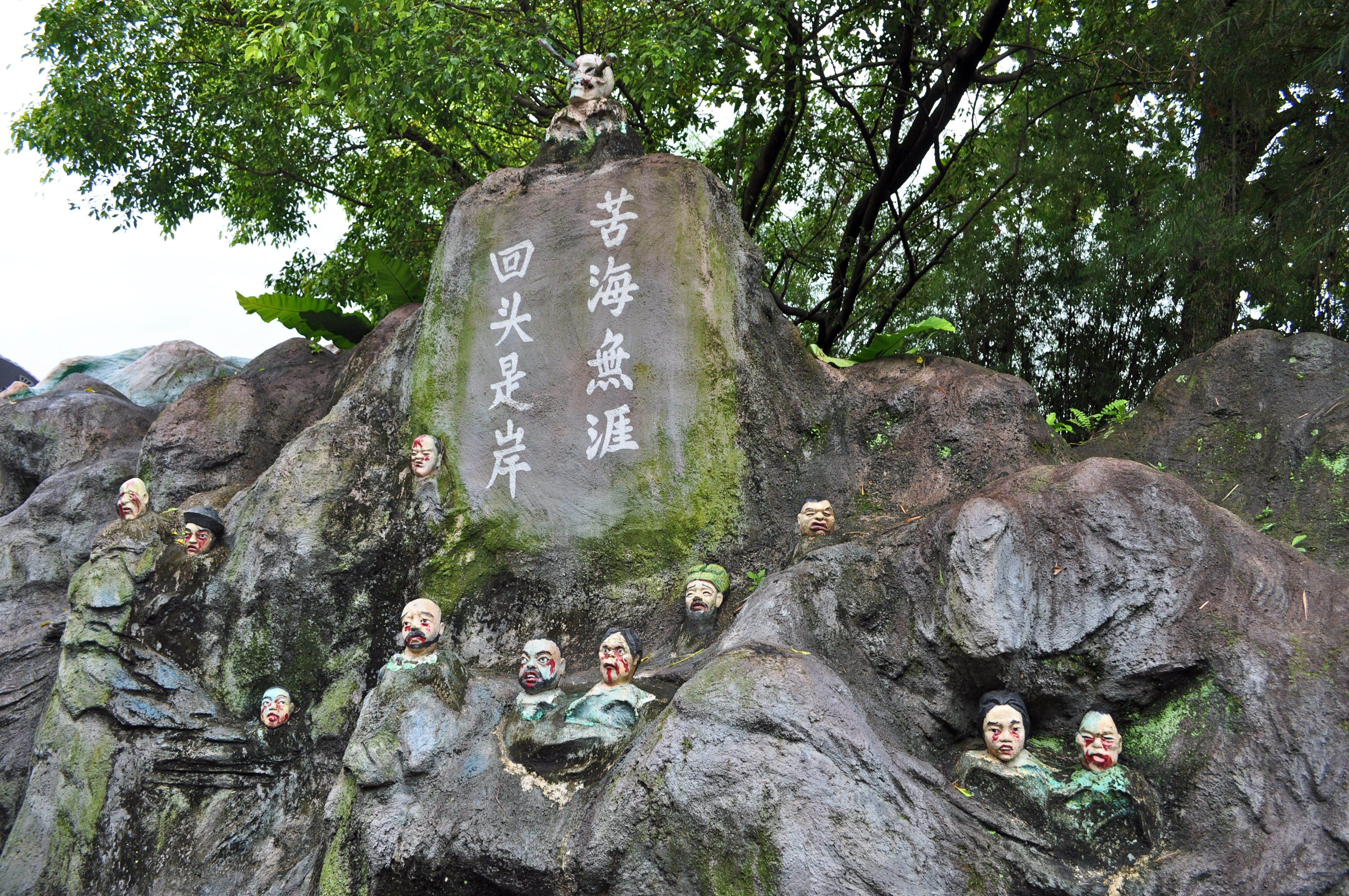
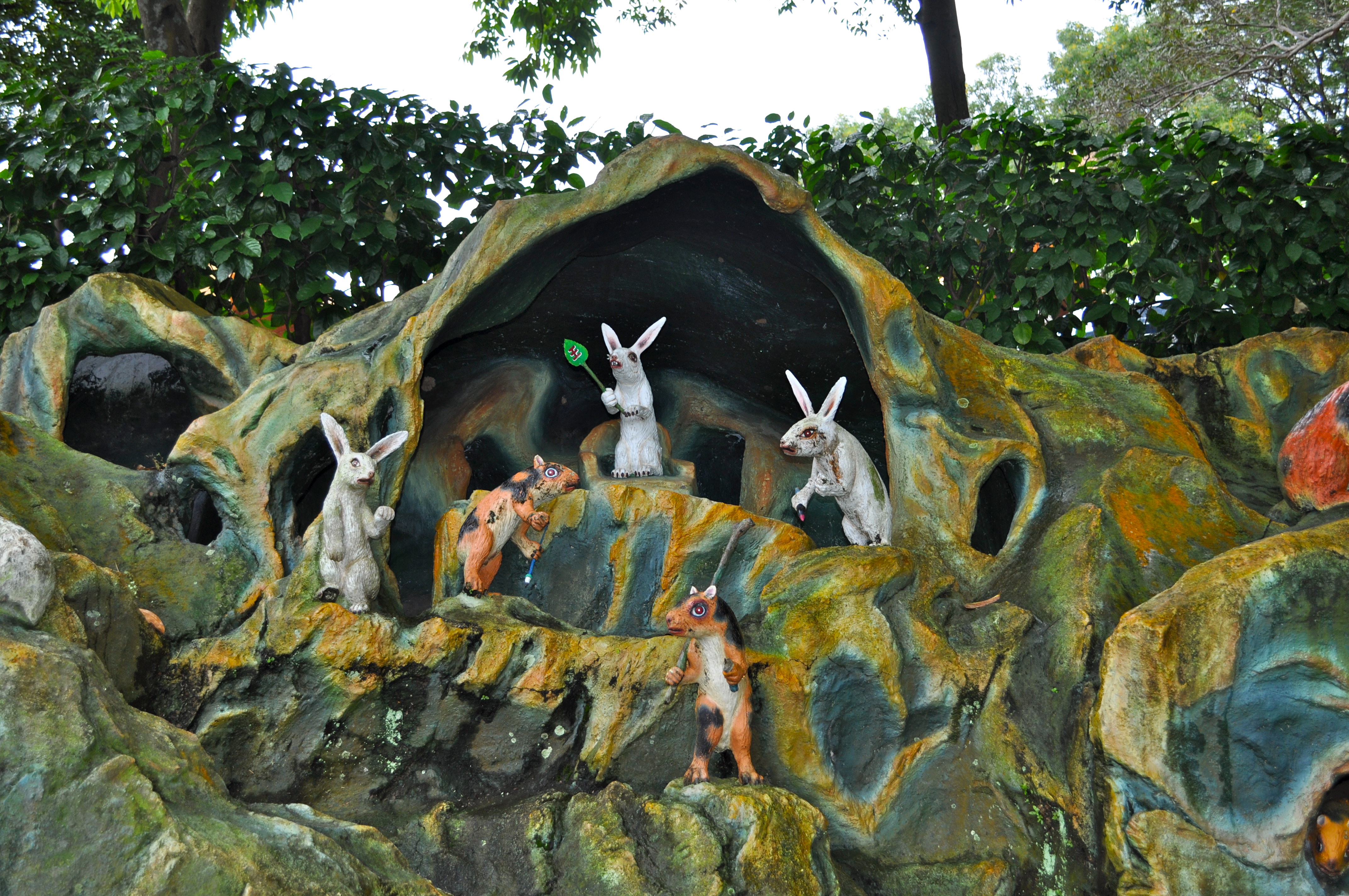
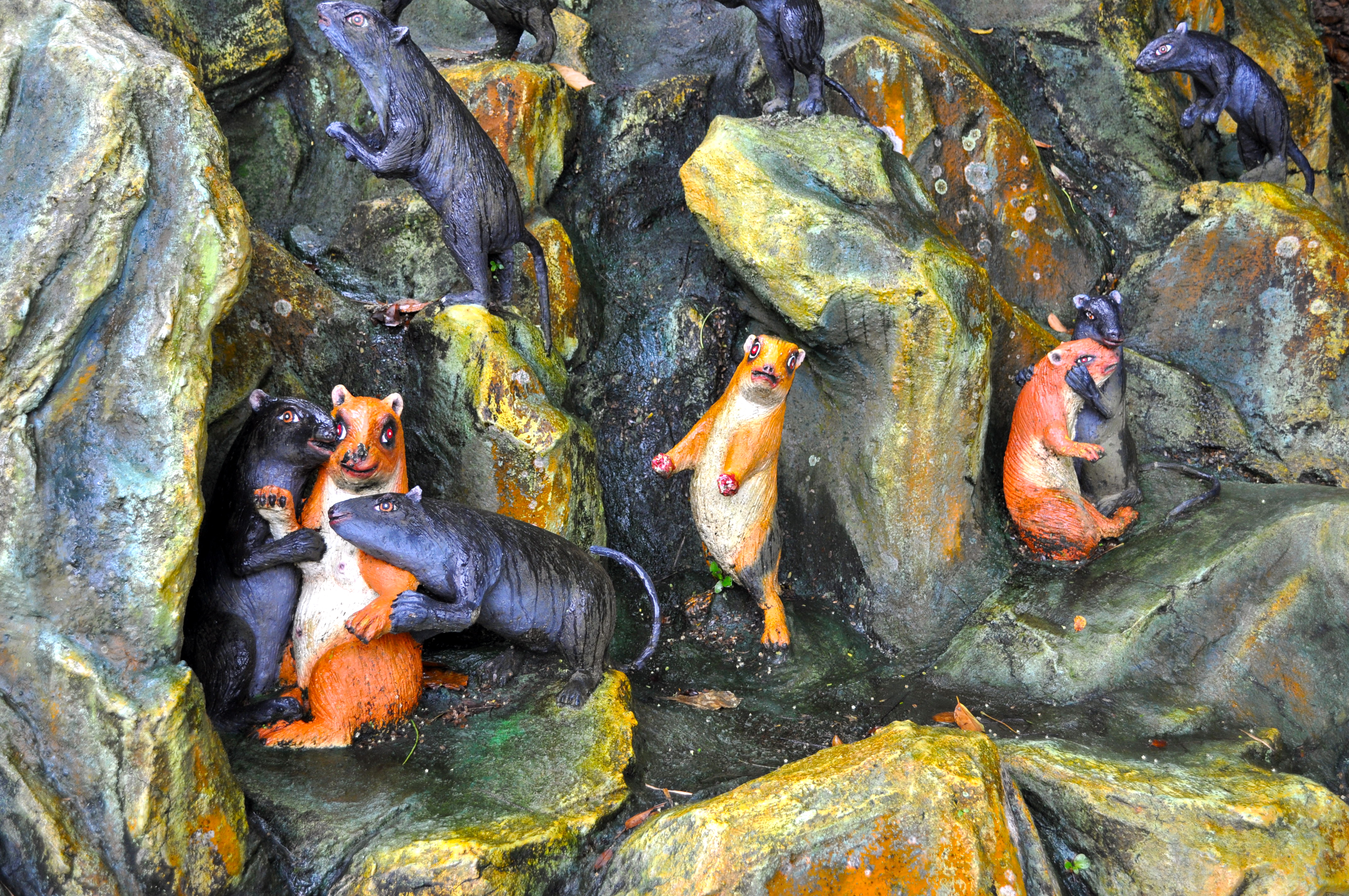
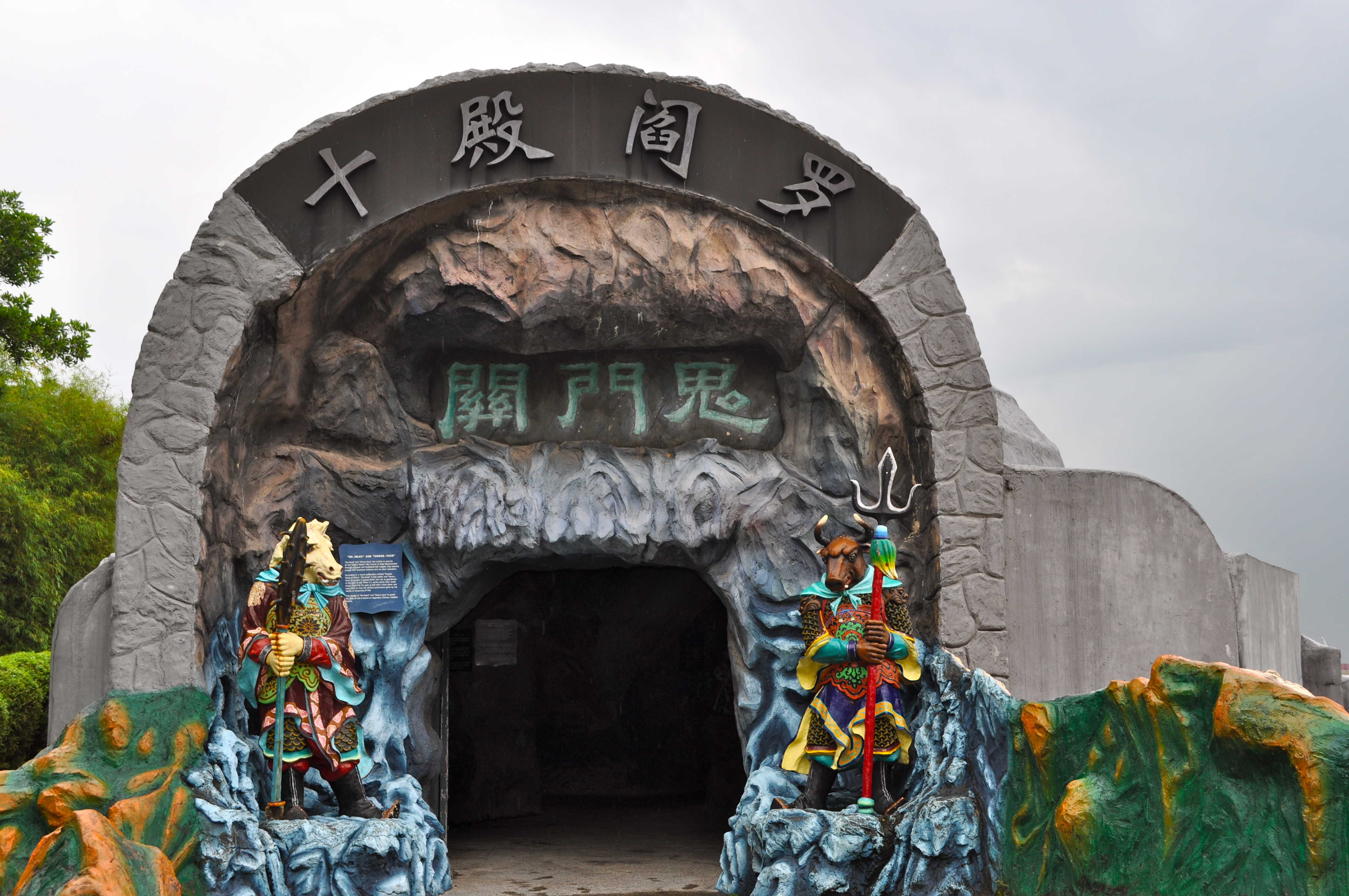
Here, you walk through a garden displaying a killer rodent battle where rabid rabbits and rats attack and maim each other. Upon passing through the entrance that is decorated with mini severed heads and two guardians, you see the 10 different courts that a person must go through where they will be judged and punished for their crimes.

DSC_0392

DSC_0393

DSC_0394

DSC_0395

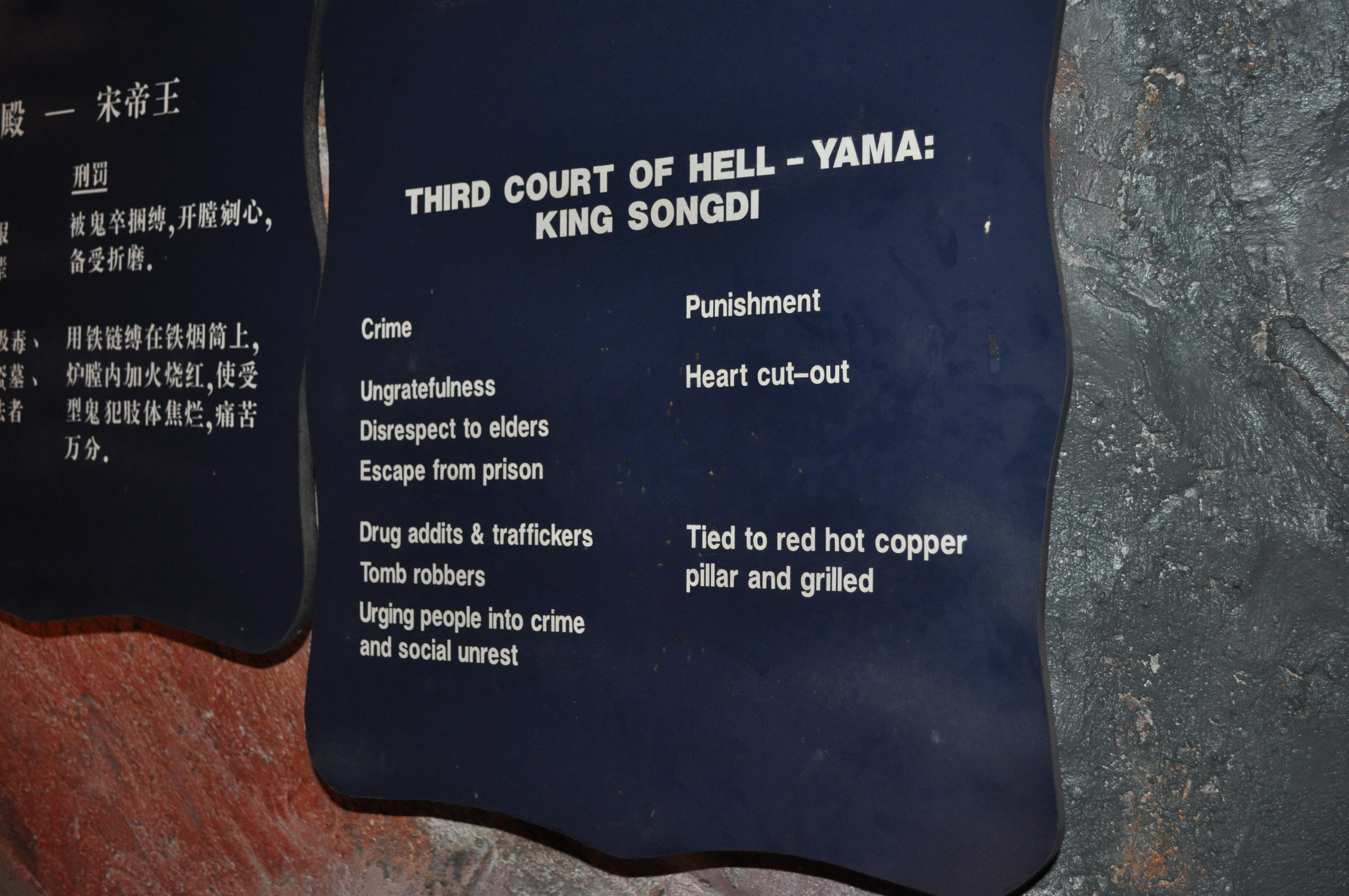
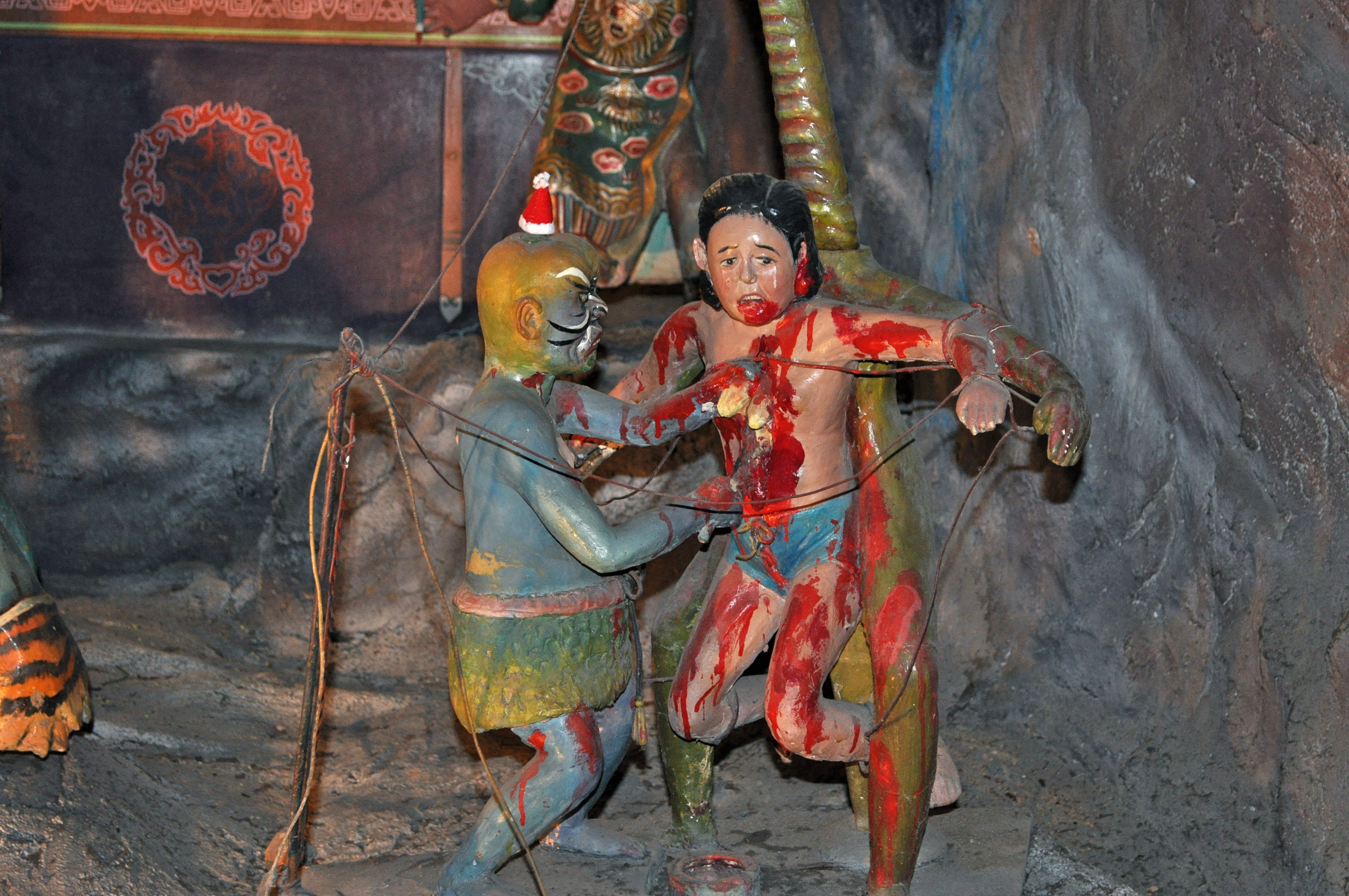
Plaques describe various crimes with corresponding punishments – those of which are shown visually with colorful statues within the cave-like structure. You know, just in case you have a weak imagination and wouldn’t know what it’s like to grind up your siblings under large stones because they didn’t obey you during your lifetimes. All crimes and punishments seem to be a way of discouraging visitors from being “bad” people. That wouldn’t justify bringing 5 year olds to such a park in my opinion but, then again, my little sister loves movies about dismemberment and the undead so what do I know about kids these days.

DSC_0396 DSC_0397

DSC_0398 DSC_0399

I read that many of the statues had been updated technologically so that they’d move, blink, and growl; however, upon my visit, they were completely stationary- at least, while I was looking at them. Due to the rainy weather, it was empty, making it all the more creepy, but the park generally seems to be a forgotten landmark.

And it is because of this that it’s definitely a place to go see: it’s weird, one-of-a-kind, and photogenic. Plus, entrance is free.

SMRT station: Haw Par Villa (Circle Line- Yellow)